Japanese Phrases: 50 Common Phrases with Meaning, Romaji, and Practice
Japanese phrases are easier to use than isolated vocabulary when you learn them as complete chunks. This guide collects common Japanese phrases for greetings, requests, travel, shops, and everyday conversation, with kana, romaji, English meaning, and a clear note about when each expression fits.

What makes a Japanese phrase useful?
A Japanese word is a useful building block, but a phrase is closer to something you can actually say. Compare みず (mizu, water) with みずをください (mizu o kudasai, water please). The second expression gives you a complete request and also shows how the word behaves in a sentence.
That is why beginners often make faster progress with a small set of common Japanese phrases than with a large list of disconnected translations. You still need vocabulary, of course. The basic Japanese words guide is a better starting point for single-word categories such as greetings, food, places, verbs, and adjectives. This page adds the next layer: expressions you can recognize and reuse as a whole.
Common Japanese phrases to start with
The table below focuses on phrases that appear in greetings, first meetings, simple requests, and basic repair conversations. The English meaning is practical rather than perfectly literal. Japanese expressions can change nuance depending on the relationship, setting, and tone.
| Japanese | Romaji | Meaning and use |
|---|---|---|
| こんにちは | konnichiwa | Hello / good afternoon; a neutral daytime greeting. |
| おはようございます | ohayou gozaimasu | Good morning; the polite form for work, school, shops, or unfamiliar people. |
| おはよう | ohayou | Good morning; casual and common with friends or family. |
| こんばんは | konbanwa | Good evening; a standard evening greeting. |
| おやすみなさい | oyasuminasai | Good night; used when someone is going to sleep or leaving for the night. |
| はじめまして | hajimemashite | Nice to meet you; used at a first meeting. |
| よろしくお願いします | yoroshiku onegaishimasu | A polite phrase used after an introduction or request; the exact English depends on context. |
| ありがとうございます | arigatou gozaimasu | Thank you; a polite everyday form. |
| ありがとう | arigatou | Thanks; casual or friendly. |
| すみません | sumimasen | Excuse me, sorry, or thank you for the trouble; useful for getting attention and repairing a small problem. |
| ごめんなさい | gomennasai | I'm sorry; a direct apology, often more personal than すみません. |
| お願いします | onegaishimasu | Please / I would like to request this; common in shops, restaurants, and polite requests. |
| どういたしまして | dou itashimashite | You're welcome; a standard response to thanks. |
| 大丈夫です | daijoubu desu | I'm okay, it is fine, or no thank you; context and tone decide the meaning. |
| わかりません | wakarimasen | I do not understand / I do not know; a polite way to signal a problem. |
Useful repair phrases for learners
Repair phrases keep a conversation moving when you miss a word. They are often more valuable than memorising a long list of perfect introductions, because they let you ask for time, repetition, or a simpler explanation.
Japanese phrases for travel and services
Travel phrases are a practical subset of common Japanese phrases, but they should not be treated as a separate language. The same polite building blocks appear in a hotel, train station, restaurant, convenience store, or museum. Learn the situation first, then swap in the noun you need.
| Japanese phrase | Romaji | When to use it |
|---|---|---|
| どこですか | doko desu ka | Where is it? Add a place before the phrase when you know the noun. |
| トイレはどこですか | toire wa doko desu ka | Where is the restroom? |
| 駅はどこですか | eki wa doko desu ka | Where is the station? |
| いくらですか | ikura desu ka | How much is it? |
| これをください | kore o kudasai | This one, please; point to an item when the name is unknown. |
| おすすめは何ですか | osusume wa nan desu ka | What do you recommend? |
| 水をください | mizu o kudasai | Water, please. |
| お会計お願いします | okaikei onegaishimasu | The bill, please; useful in a restaurant. |
| 予約しています | yoyaku shiteimasu | I have a reservation. |
| 助けてください | tasukete kudasai | Please help me; reserve for situations where you genuinely need help. |
Casual vs polite Japanese phrases
Japanese formality is not a simple “beginner versus advanced” scale. It is a relationship and situation choice. Polite phrases are safer with strangers, staff, teachers, older adults, and workplace contacts. Casual phrases belong with close friends, family, and people who have clearly invited a relaxed style.
| Purpose | More casual | More polite / neutral | Beginner note |
|---|---|---|---|
| Good morning | おはよう | おはようございます | Use the polite form outside close relationships. |
| Thanks | ありがとう | ありがとうございます | The longer form is a useful default in shops and services. |
| Sorry / excuse me | ごめん | すみません / ごめんなさい | すみません is especially useful for getting attention. |
| Please | お願い | お願いします | Learn お願いします as a complete polite chunk. |
| See you | またね / じゃあね | また会いましょう | Choose based on relationship and how definite the next meeting is. |
You do not need to master every honorific ending before speaking. A good beginner strategy is to memorise a small polite core, recognise a few casual alternatives, and avoid copying casual media dialogue into every real conversation. The goal is appropriate communication, not a perfect translation of one English sentence.
How to practise Japanese phrases
Memorising Japanese phrases works best when you alternate recognition and recall. First read the kana and understand the meaning. Then cover the English, say the phrase aloud, and try to bring it back the next day without looking. This route is more useful than repeatedly rereading a long list.
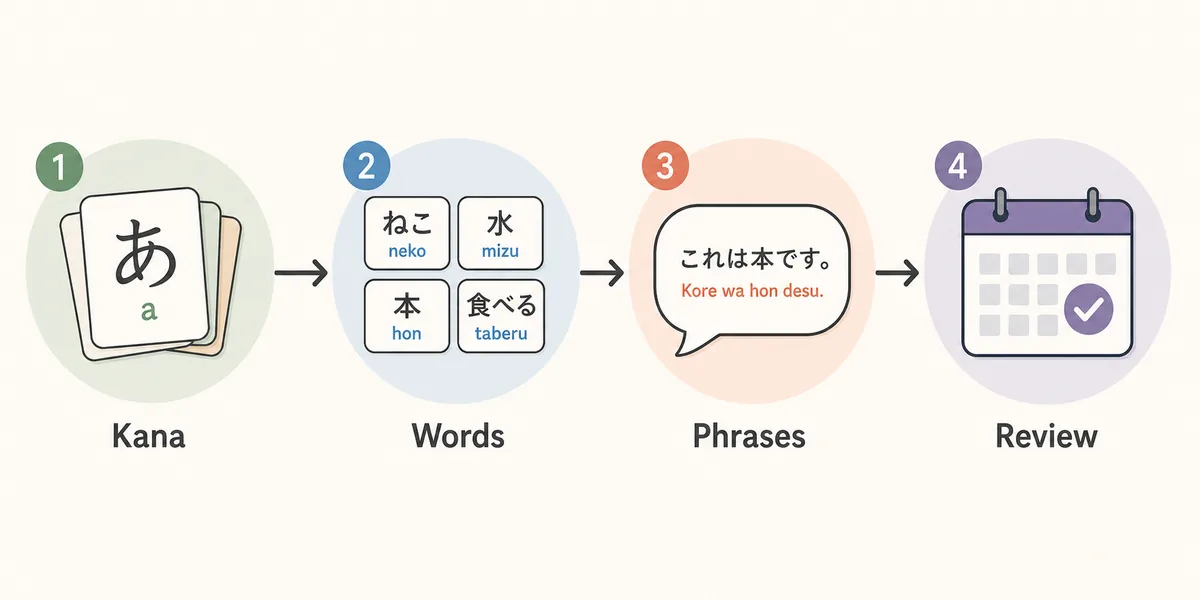
- Choose five phrases from one situation, such as greetings or ordering food.
- Read the kana before checking romaji. Mark the part that is difficult to recognise.
- Say each phrase three times: slowly, at normal speed, and inside a short imagined scene.
- Write one substitution, such as changing みず to おちゃ in a request pattern.
- Cover the meaning and recall it from the Japanese phrase the following day.
- Move phrases you can recall into a small review list instead of adding new items immediately.
Seven-day Japanese phrase practice route
| Day | Focus | Small target |
|---|---|---|
| 1 | Greetings | こんにちは, おはようございます, こんばんは, おやすみなさい |
| 2 | Thanks and apologies | ありがとう, ありがとうございます, すみません, ごめんなさい |
| 3 | Requests | お願いします, これをください, 水をください |
| 4 | Repair phrases | わかりません, もう一度お願いします, ゆっくりお願いします |
| 5 | Directions and prices | どこですか, いくらですか, トイレはどこですか |
| 6 | Politeness check | Sort each phrase into friend, stranger, shop, or teacher context. |
| 7 | Recall day | Write or say ten phrases from memory before checking the list. |
Words, phrases, and sentences: which page should you use?
Search results for Japanese vocabulary often mix words, phrases, sentences, and games. Those needs are related, but they are not identical. Use the page that matches the task you are trying to complete instead of forcing every keyword into one giant list.
| Search need | Best fit on this site | Why |
|---|---|---|
| Basic Japanese words | Basic Japanese Words | Single words grouped by category with romaji, meanings, and a beginner review order. |
| Common Japanese phrases | This page | Reusable expressions, polite/casual context, travel requests, and phrase practice. |
| Hiragana words | Hiragana Words | Kana-first word examples and a route from character recognition to word recall. |
| Hiragana chart or writing order | Hiragana Chart | Character rows, voiced sounds, combined sounds, and a chart-based practice order. |
| Japanese learning games | Japanese Learning Games | Compare kana practice, vocabulary games, and Wordle-style recall by learning stage. |
Use a word game for phrase recall
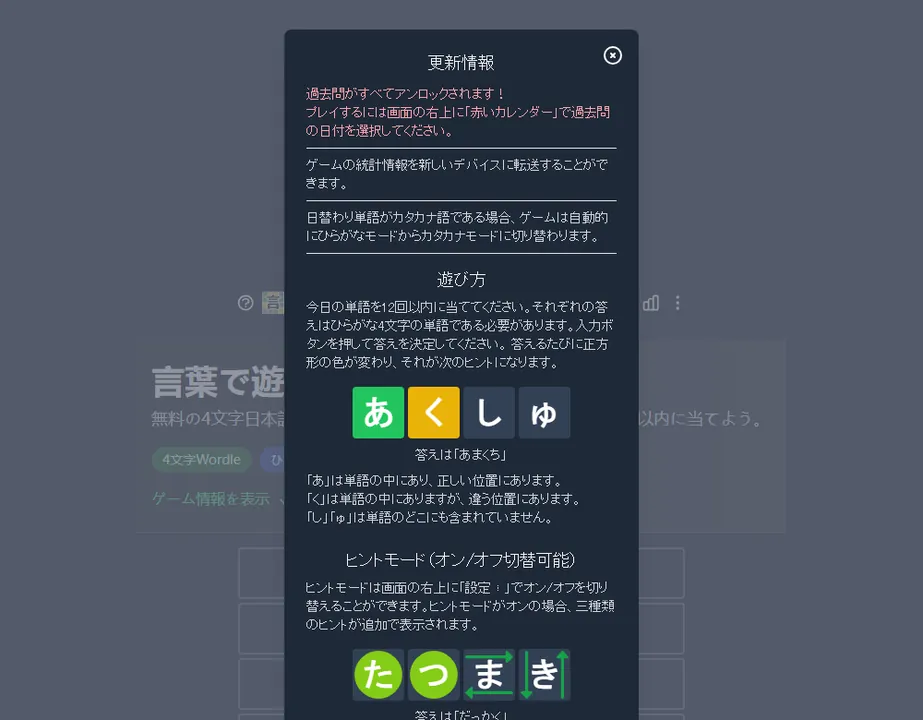
A word game is not a replacement for listening or grammar study, but it can make kana and word-shape recall more active. After you know the meaning of a small phrase set, a short game can help you notice whether you recognise Japanese characters quickly or still translate every sound through English letters.
FAQ
What is the difference between a Japanese word and a Japanese phrase?
A word names one item or idea, while a phrase combines words into a reusable expression such as ありがとうございます or どこですか. Phrases are useful because they give you a complete chunk to recognise and use. Start with the basic Japanese words list when you need individual vocabulary, then return here for expressions.
Should beginners learn casual or polite Japanese phrases first?
Start with polite phrases for travel, shops, school, and unfamiliar adults. Learn the casual pair when you can recognise who is speaking and why the register changes. This keeps your first phrases useful without encouraging you to use friend-to-friend language everywhere.
Do Japanese people really use different phrases based on formality?
Yes. The same purpose can be expressed casually with a friend and more politely with a customer, teacher, stranger, or workplace contact. The relationship and situation matter as much as the literal translation. When unsure, use the polite form and observe the response.
How many Japanese phrases should I learn per day?
Five phrases per day is a practical starting point when you read the kana, say the phrase, check the romaji, and recall the meaning again the next day. If you cannot remember yesterday's five, pause new additions and review them in a short spoken set.
Are these Japanese phrases enough for a trip?
They cover greetings, requests, directions, prices, restaurants, and basic repair phrases, but they do not replace a full travel phrasebook or the ability to read signs and understand replies. Treat them as a compact first layer that helps you start polite interactions.
Summary
The most useful Japanese phrases are the ones you can recognise, say, and adapt to a real situation. Begin with polite greetings, thanks, apologies, requests, directions, and repair phrases. Learn kana first, keep romaji as a temporary bridge, and practise five phrases at a time rather than collecting an enormous list.
Once the core expressions feel familiar, compare casual and polite pairs and use a short vocabulary game to test recall. If you need individual words, continue with the basic vocabulary and hiragana words guides; if you want a broader route through game-based study, see Japanese learning games.
Practice Japanese word recall
After learning a small set of phrases, try a short kana-based word game. Kotobade Asobou gives you a compact way to practise Japanese word shapes and daily vocabulary recall.
Play Kotobade AsobouSources and further reading
For broader beginner communication practice, see the Japan Foundation's Irodori: Japanese for Life in Japan materials. The examples on this page are reorganised for quick phrase recall, kana reading, politeness awareness, and word-game practice; the English glosses are practical guides rather than word-for-word translations.