Basic Japanese Words: 100 Common Words, Romaji, Meanings, and Practice Order
Basic Japanese words are easiest to remember when you learn them by use, not by alphabetical order. A beginner does not need a thousand random entries on day one. You need a compact Japanese vocabulary list you can read, say, recognize in kana, and reuse in short phrases.
How to use this basic Japanese words list
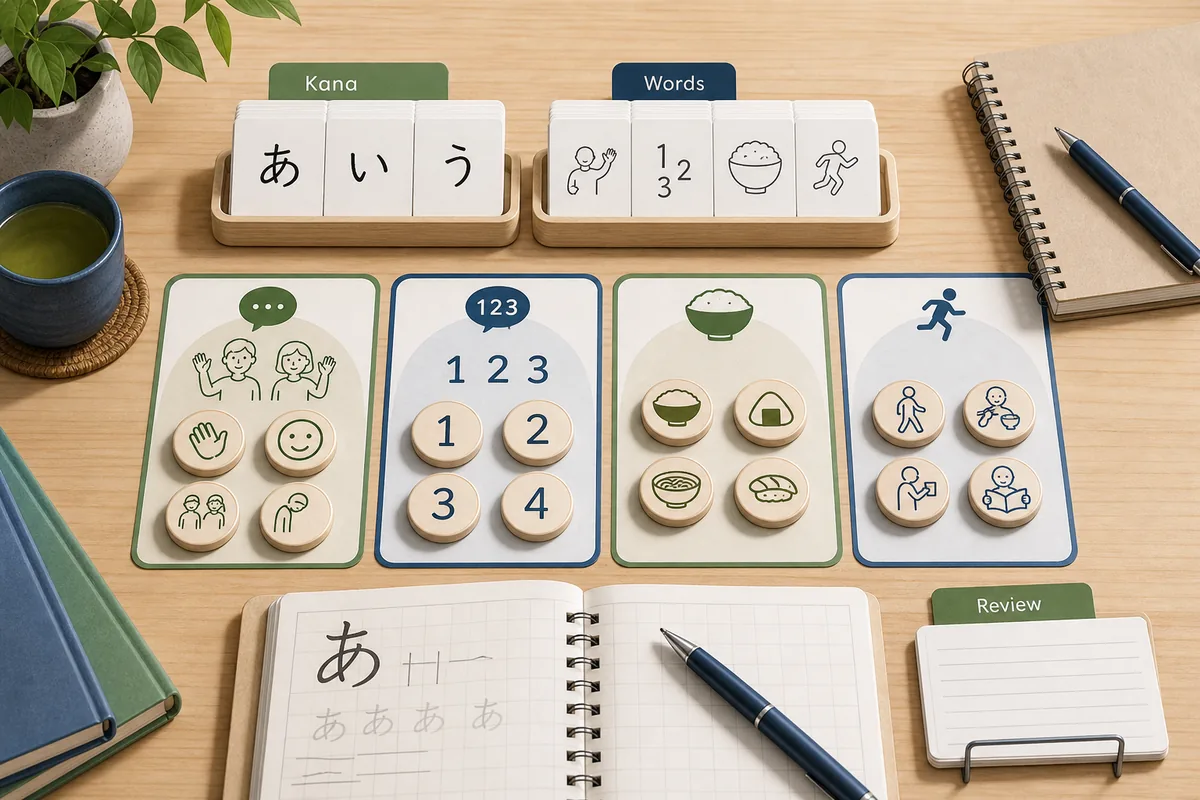
Many pages about Japanese words give a very long list. That can be useful later, but beginners often need a smaller structure first: what to learn today, what to say out loud, what to write in kana, and what to review tomorrow. This guide groups common Japanese words by practical use, then shows how to turn them into a daily review routine.
Each table includes Japanese script, romaji, and English meaning. Romaji is included because many absolute beginners search for Japanese words before they can read hiragana. Still, treat romaji as a bridge. JapanesePod101's romaji guide also warns learners not to depend on romanization forever, because kana is the basis for reading and typing Japanese naturally.
Start here: greetings and polite words
Greetings are the safest first category because you can use them immediately. Several beginner resources, including Preply, Coto Academy, and Transparent Language, start with greetings such as こんにちは, ありがとう, すみません, and おはようございます because they appear in daily interactions.
| Japanese | Romaji | Meaning | Use note |
|---|---|---|---|
| こんにちは | konnichiwa | hello / good afternoon | Safe daytime greeting |
| おはようございます | ohayou gozaimasu | good morning | Polite morning greeting |
| こんばんは | konbanwa | good evening | Used later in the day |
| ありがとう | arigatou | thank you | Casual thanks |
| ありがとうございます | arigatou gozaimasu | thank you very much | Polite and widely useful |
| すみません | sumimasen | excuse me / sorry | Use for attention, apology, or thanks |
| ごめんなさい | gomennasai | I am sorry | More direct apology |
| お願いします | onegaishimasu | please | Useful when requesting something |
Yes, no, and everyday response words
These small words are more powerful than they look. They help you answer, confirm, pause, and keep a conversation moving. Wiktionary's basic Japanese word appendix includes common function words such as はい, いいえ, この, その, もう, and まだ because high-frequency words appear across many sentence patterns.
People and pronouns
You do not need to use pronouns in every Japanese sentence, but beginners should recognize the most common people words. They help you understand examples, short dialogues, and vocabulary games.
| Japanese | Romaji | Meaning |
|---|---|---|
| わたし | watashi | I / me |
| あなた | anata | you |
| ひと | hito | person |
| ともだち | tomodachi | friend |
| せんせい | sensei | teacher |
| がくせい | gakusei | student |
| かぞく | kazoku | family |
| こども | kodomo | child |
Numbers, time, and days
Numbers and time words turn vocabulary into real-life communication. Even if you cannot build long sentences yet, these words help with prices, schedules, birthdays, daily routines, and classroom examples.
| Japanese | Romaji | Meaning | Beginner use |
|---|---|---|---|
| いち | ichi | one | Counting basics |
| に | ni | two | Counting basics |
| さん | san | three | Counting basics |
| じかん | jikan | time / hour | Schedules |
| きょう | kyou | today | Daily plans |
| あした | ashita | tomorrow | Future plans |
| きのう | kinou | yesterday | Past events |
| まいにち | mainichi | every day | Study routines |
Core verbs to learn early
Verbs give your vocabulary movement. A list of nouns is easy to scan, but common verbs let you say what you do, want, see, eat, hear, and understand. Several high-frequency word lists include verbs such as する, いく, くる, たべる, のむ, みる, きく, and わかる because they appear across beginner phrases.
| Japanese | Romaji | Meaning | Simple phrase |
|---|---|---|---|
| する | suru | to do | べんきょうする - study |
| いく | iku | to go | がっこうにいく - go to school |
| くる | kuru | to come | あしたくる - come tomorrow |
| たべる | taberu | to eat | ごはんをたべる - eat a meal |
| のむ | nomu | to drink | みずをのむ - drink water |
| みる | miru | to see / watch | えいがをみる - watch a movie |
| きく | kiku | to hear / ask | おんがくをきく - listen to music |
| わかる | wakaru | to understand | にほんごがわかる - understand Japanese |
Adjectives and useful description words
Description words help you talk about size, taste, feeling, and difficulty. Do not memorize them as isolated translations only. Pair each adjective with one noun or one short sentence.
Food, places, and daily-life nouns
Beginner Japanese vocabulary should include nouns you can point to or imagine quickly. That makes recall easier. Use these words in short phrase patterns such as "I eat ___", "I go to ___", or "This is ___".
| Category | Japanese words | Romaji and meaning |
|---|---|---|
| Food and drink | ごはん / みず / おちゃ / さかな / やさい | gohan meal, mizu water, ocha tea, sakana fish, yasai vegetables |
| Places | いえ / がっこう / えき / みせ / びょういん | ie home, gakkou school, eki station, mise shop, byouin hospital |
| Objects | ほん / つくえ / かばん / くるま / でんわ | hon book, tsukue desk, kaban bag, kuruma car, denwa phone |
| Study words | にほんご / ことば / いみ / れんしゅう / こたえ | nihongo Japanese, kotoba word, imi meaning, renshuu practice, kotae answer |
How to turn a list into memory
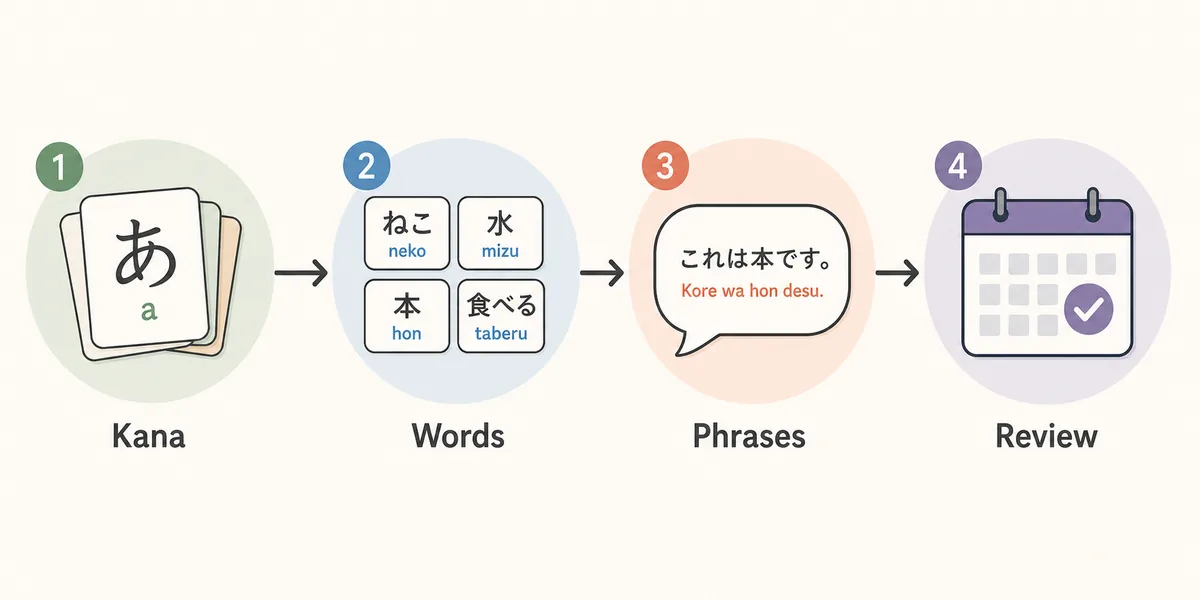
Reading a list once is recognition, not memory. To remember Japanese words, use a loop: read the kana, say the romaji only if needed, cover the English meaning, make one short phrase, then review tomorrow. This is slower than scrolling through 500 entries, but it creates recall.
- Pick 5 to 10 words from one category, not from every category at once.
- Read each word in kana before looking at romaji.
- Say one phrase aloud, such as みずをのむ or がっこうにいく.
- Review yesterday's words before adding new words.
- Use a word game once you can recognize the kana shape.
Practice basic Japanese words with a word game
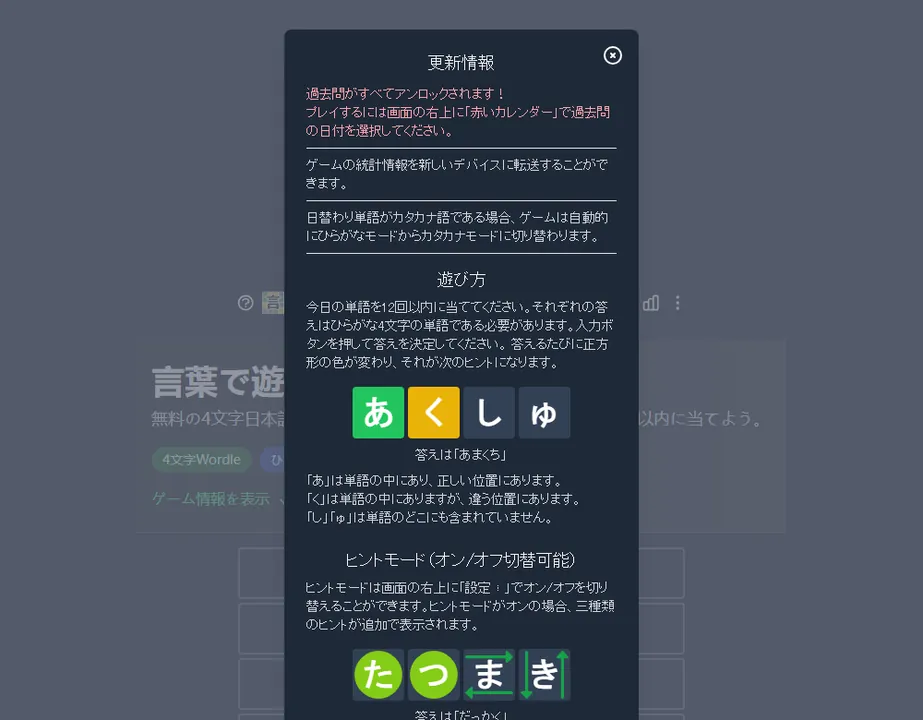
A word game does not replace grammar study, but it is useful for vocabulary recall. In Kotobade Asobou, you work with short Japanese word shapes and kana-based hints. That makes it a good follow-up after you have learned a small set of words and want to practice remembering sounds under pressure.
Common mistake: learning only romaji
Romaji is convenient at the start, but it can slow you down if it becomes the main script in your head. Japanese words are normally written in kana and kanji. If you always read "arigatou" first, you may struggle to recognize ありがとう quickly. A balanced beginner table should show kana first, then romaji, then meaning.
A practical rule is simple: use romaji to check pronunciation, but test yourself from kana. For example, look at たべる and ask "what does this mean?" before looking at taberu. This small shift makes later reading practice much easier.
Which keywords belong on this page?
If you searched for "Japanese words", "basic Japanese words", "common Japanese words", or "Japanese vocabulary", this page is meant to be a starting point. If you specifically want kana-first examples, use the focused hiragana words guide. For katakana rows, voiced sounds, and reading practice, use the katakana chart. If you want reusable expressions instead of isolated words, continue with the Japanese phrases guide. If you want game-specific word lists, use 4-letter Japanese words, 5-letter Japanese words, or shiritori word list. Those pages are organized for narrower practice needs; this page is organized for beginner learning.
| Search need | Best page | Why |
|---|---|---|
| Basic Japanese words | This page | Beginner vocabulary by category with romaji and meaning |
| Common Japanese words | This page | High-frequency words and practical review order |
| Common Japanese phrases | Japanese phrases guide | Reusable expressions, polite/casual context, and travel requests |
| Hiragana words | Hiragana words guide | Kana-first words, romaji, meanings, and word-game practice notes |
| Japanese Wordle words | Japanese Wordle guide | Game rules, 4-letter vs 5-letter practice, and strategy |
| 4-letter Japanese words | 4-letter words list | Wordle-style candidate words and kana-position thinking |
| Shiritori words | shiritori word list | Words grouped for word-chain play |
FAQ
What are the best basic Japanese words to learn first?
Start with reusable words: greetings, yes/no words, polite expressions, people words, numbers, common verbs, adjectives, food, places, and time words. These categories appear in beginner conversations and are easy to practice in short phrases.
Should beginners learn Japanese words with romaji?
Romaji is useful as a temporary pronunciation bridge, especially before you know hiragana. However, every romaji form should be paired with kana. Your review should move from Japanese script to meaning, not only from romaji to English.
How many Japanese words should I learn per day?
Five to ten words per day is enough for most beginners if you review old words and create short phrases. Learning fifty words at once feels productive, but it often creates recognition without recall.
Are Japanese words easier to learn by category?
Yes. Categories such as greetings, verbs, food, places, and time words give your memory context. Category learning also helps you build short phrases faster than random alphabetical lists.
Can word games help with Japanese vocabulary?
Yes, if you use them for review. Word games help you recall kana and word shapes, but they work best after you already know the reading and meaning of a small set of words.
Summary
Basic Japanese words become useful when they move from a list into recall. Start with greetings, response words, people, numbers, verbs, adjectives, food, places, and time. Use romaji only as a bridge, keep kana visible, and review with short phrases before adding more words.
Once the first words feel familiar, use a short Japanese word game to practice recall. The goal is not to memorize every word at once. The goal is to recognize kana, remember meaning, and bring the right word back when you need it.
Practice Japanese word recall
After learning a small group of words, try a short kana-based word game. Kotobade Asobou gives you a compact way to practice Japanese word shapes and daily vocabulary recall.
Play Kotobade AsobouSources and further reading
SERP and vocabulary structure were checked against beginner vocabulary resources including Preply's basic Japanese words guide, Coto Academy's basic Japanese words list, Transparent Language's basic Japanese phrases, Wiktionary's 1000 Japanese basic words appendix, and JapanesePod101's romaji guide. This page reorganizes the topic around beginner recall and word-game practice rather than copying any single list order.