Hiragana Chart: 46 Basic Characters, Dakuten, and Practice Order
A hiragana chart is most useful when it helps you read real Japanese, not when it stays as a page of symbols to memorize. This guide puts the 46 basic characters first, then adds dakuten, handakuten, small kana, pronunciation notes, and a realistic practice order. Use the chart as a reference, but move quickly into short words so the kana become readable shapes rather than isolated flashcards.
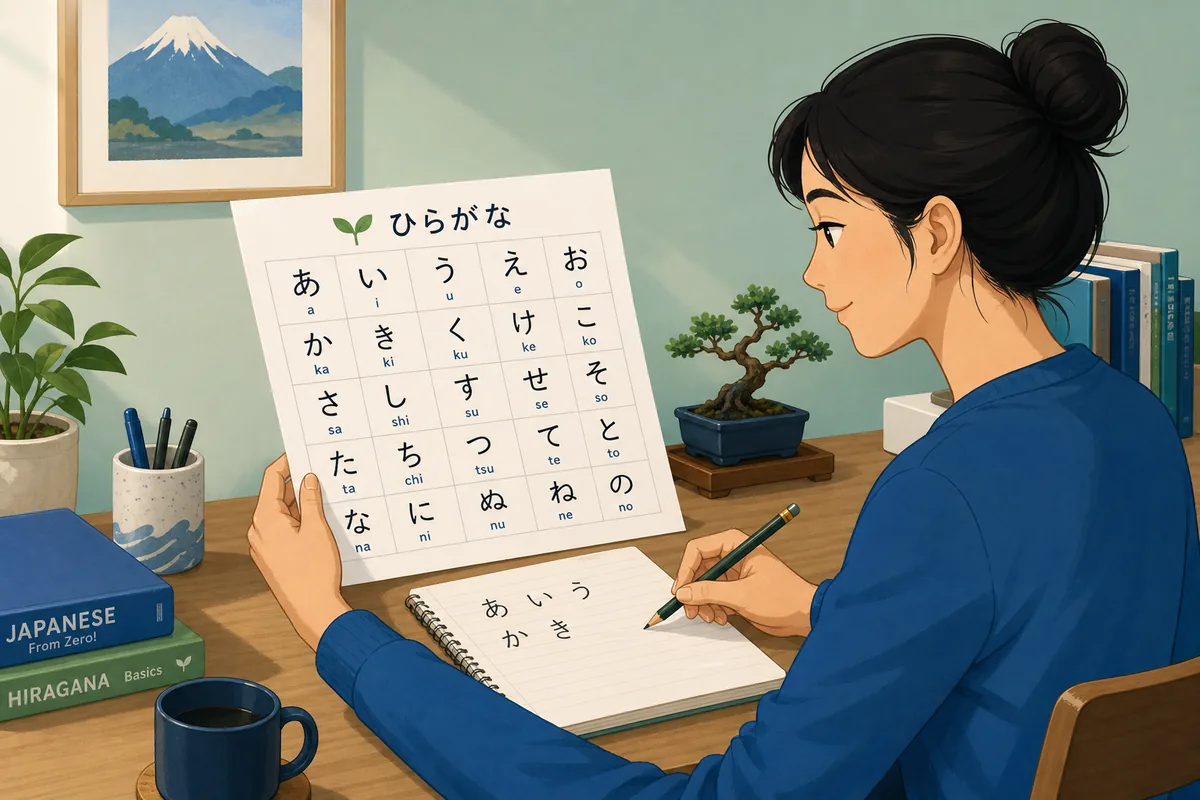
Hiragana chart at a glance
The basic chart is usually called the gojuon, or “fifty sounds,” even though the modern standard chart contains 46 basic hiragana characters. The missing-looking cells in the y and w rows are not mistakes: Japanese does not use every possible consonant-vowel combination in the modern basic set.
| Row | Hiragana | Romaji | Practice cue |
|---|---|---|---|
| Vowels | あ い う え お | a i u e o | Start here; read the five sounds in order. |
| K row | か き く け こ | ka ki ku ke ko | Keep the vowel order visible. |
| S row | さ し す せ そ | sa shi su se so | Remember し is “shi,” not “si.” |
| T row | た ち つ て と | ta chi tsu te to | Remember the special sounds ち and つ. |
| N row | な に ぬ ね の | na ni nu ne no | A regular row that is good for handwriting drills. |
| H row | は ひ ふ へ ほ | ha hi fu he ho | ふ is often written as “fu,” not a hard “hu.” |
| M row | ま み む め も | ma mi mu me mo | Practice as a rhythm with the vowel pattern. |
| Y row | や ・ ゆ ・ よ | ya yu yo | There are no modern basic yi or ye cells. |
| R row | ら り る れ ろ | ra ri ru re ro | The Japanese r sound is lighter than English r. |
| W row | わ ・ ・ ・ を | wa wo | を is usually pronounced “o” as a particle. |
| Final nasal | ん | n | It changes slightly depending on the following sound. |
Pronunciation notes that matter early
Most rows are predictable because the vowel pattern repeats. The first reading problems usually come from a small group of kana that are represented differently in romaji systems. Treat these as fixed checkpoints rather than exceptions to fear.
- し is usually written shi, as in しお (shio, salt).
- ち is chi, and つ is tsu.
- ふ is commonly written fu; its sound is softer than an English f.
- を is written wo in charts but is normally pronounced o when it marks an object.
- ん is the only basic kana that represents a final nasal sound rather than a vowel-ending syllable.
Dakuten and handakuten: the second layer
Dakuten are the two small marks that turn several unvoiced kana into voiced sounds. Handakuten is the small circle used with the h row to make p sounds. These marks do not create a completely new chart; they extend rows you already know.
| Base row | Dakuten | Romaji | Handakuten |
|---|---|---|---|
| か き く け こ | が ぎ ぐ げ ご | ga gi gu ge go | — |
| さ し す せ そ | ざ じ ず ぜ ぞ | za ji zu ze zo | — |
| た ち つ て と | だ ぢ づ で ど | da ji zu de do | — |
| は ひ ふ へ ほ | ば び ぶ べ ぼ | ba bi bu be bo | ぱ ぴ ぷ ぺ ぽ = pa pi pu pe po |
The practical order is simple: recognize the base kana first, then compare each voiced pair. For example, か and が share the same row position, while ほ, ぼ, and ぽ show the three useful versions of the h row. This makes a chart easier to review than a random list of extra symbols.
Small ゃ・ゅ・ょ, っ, and combined sounds
Small kana change how a sound is read. The most common combinations join an i-row kana with small ゃ, ゅ, or ょ: きゃ is kya, しゅ is shu, and ちょ is cho. The small っ marks a brief pause or doubled consonant, as in きって (kitte, stamp).
| Pattern | Examples | Reading | What to notice |
|---|---|---|---|
| K row + small kana | きゃ きゅ きょ | kya kyu kyo | The small kana is not a full extra beat. |
| S row + small kana | しゃ しゅ しょ | sha shu sho | し changes from shi to an sh sound. |
| Ch row + small kana | ちゃ ちゅ ちょ | cha chu cho | Read the pair as one combined sound. |
| Small pause | きって, さっき | kitte, sakki | っ is a pause or consonant doubling, not “tsu.” |
Hiragana chart stroke order and handwriting
A static chart is enough for recognition, but handwriting improves when you practice stroke direction and proportion. Do not try to write the whole chart repeatedly in one sitting. Choose one row, copy each kana slowly, then write it from memory on a blank line. The goal is consistent shape, not calligraphy.
- Look at one kana and say its sound before writing it.
- Copy the stroke order two or three times while watching the proportions.
- Cover the model and write the kana from memory.
- Read a short word containing the kana, such as ねこ, みず, or さかな.
For a listening and recognition drill, the MARUGOTO Plus hiragana drill lets learners hear a sound and choose the matching kana. For a broader explanation of why hiragana is the foundation for Japanese reading, see Tofugu’s Learn Hiragana guide.
A four-stage practice order
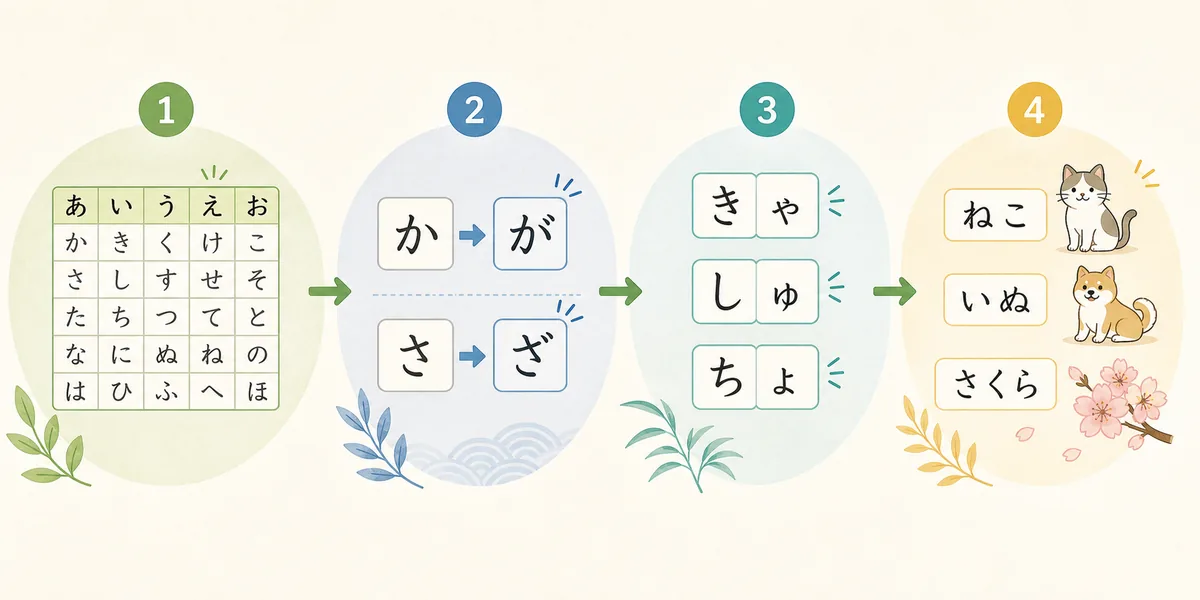
Ten focused minutes a day is a better starting routine than a single long cram session. Review yesterday’s row first, add a small new group, and finish by reading five short words. When you make a mistake, write the confusing pair together: さ/き, ぬ/め, れ/ね, or わ/ね. Similar-looking kana improve through contrast.
Hiragana vs katakana: which chart should you use?
Hiragana and katakana represent the same basic sound system, but they appear in different situations. Hiragana is common in grammar, native Japanese words, and beginner reading. Katakana is common in loanwords, many foreign names, and emphasis. You do not need to choose one forever; learn hiragana first if you are building a reading foundation, then use the katakana chart to compare the same sound rows in the second script.
| Search or study need | Best next step | Why |
|---|---|---|
| hiragana chart | This page | Basic rows, voiced marks, combinations, and practice order. |
| hiragana words | Hiragana Words | Common words with romaji, meanings, and word-length practice. |
| katakana chart | Katakana Chart | Katakana rows, voiced sounds, long vowels, and small ッ. |
| basic Japanese words | Basic Japanese Words | Broader vocabulary by category rather than kana chart order. |
| Japanese Wordle practice | Four-letter Japanese words | Short kana patterns for word-game recall. |
Use the chart to read short Japanese words
The chart is a reference, not the finish line. Once you know a small group of kana, use words to test whether you can recognize them in sequence. Start with concrete two- or three-kana words such as いえ (house), ねこ (cat), いぬ (dog), そら (sky), みず (water), and やま (mountain). Then add longer words such as さかな (fish) and ことば (word).
The existing hiragana words guide is the natural follow-up when you want meanings and romaji. If you are learning Japanese through games, the Japanese Wordle guide explains how fixed word length and color hints change the reading task, while the shiritori word list focuses on the final kana of each word.
FAQ
How many basic hiragana characters are there?
There are 46 basic hiragana characters in the standard chart. Dakuten, handakuten, small kana, and combined sounds are additional forms built from those basic rows.
What is the difference between hiragana and katakana?
Hiragana is common for grammar, native Japanese words, and beginner reading. Katakana is common for loanwords, many foreign names, and emphasis. The two scripts represent the same basic sound rows, but their shapes and typical uses differ.
Should I learn dakuten with the basic chart?
Learn the basic 46 first, then add dakuten and handakuten as a second layer. Pairing each voiced form with its base kana makes the patterns easier to remember.
Where can I learn hiragana first easily?
Use the chart for a small row group, practice listening or handwriting, and finish with short words. A daily review of five to ten kana is more useful than memorizing the entire chart once and leaving it unused.
What should I study after the hiragana chart?
Study dakuten and handakuten, then small ゃ・ゅ・ょ, っ, and short words. After that, compare the same sound rows in katakana and begin reading simple Japanese sentences.
Summary
A useful hiragana chart has three jobs: show the 46 basic characters clearly, give you a way to compare related sounds, and lead you into real reading. Learn the rows in order, keep special pronunciations visible, and add dakuten and small kana only after the base shapes are comfortable.
The fastest way to make the chart stick is to use it briefly and then read words. Connect each new kana to a sound, a written shape, and a short Japanese word. That combination is more durable than repeated chart copying alone.
Practice short Japanese word shapes
After reviewing a few hiragana rows, try a short word game to test kana order and recall. Kotobade Asobou gives you a compact way to practice Japanese word shapes in the browser.
Play Kotobade AsobouSources and further reading
The chart order and kana examples were checked against MARUGOTO Plus from the Japan Foundation, including its hiragana drill. Beginner learning sequence and mnemonic advice were compared with Tofugu’s Learn Hiragana guide. The article reorganizes those fundamentals into a chart-first practice route and does not replace pronunciation instruction from a teacher or audio course.