Japanese Particles: は, が, を, に and More Explained
Japanese particles are small, but they tell the listener how each part of a sentence fits together. This practical guide explains the most useful particles by role, then shows how to choose between common pairs without memorizing isolated translations.

What Japanese particles do
In English, word order often tells us who did what. Japanese is more flexible because particles mark the relationship after a noun or phrase. In 私は本を読みます (watashi wa hon o yomimasu), は marks the topic “I,” を marks the book as the object, and the verb comes at the end. The particles do not simply replace English prepositions; they help the listener track the sentence structure.
Some particles are pronounced differently from their spelling. When は is a particle, it is read wa, and へ is read e. を is usually pronounced o. Learn these sounds early so listening practice does not feel disconnected from the written form.
Core Japanese particle chart
The chart below covers the particles you will meet most often in beginner Japanese. The examples are intentionally short so you can change one part and hear the difference.
| Particle | Main role | Example | Natural meaning |
|---|---|---|---|
| は (wa) | Topic or contrast | 私は学生です。 Watashi wa gakusei desu. | As for me, I am a student. |
| が (ga) | Focused subject or new information | 猫がいます。 Neko ga imasu. | There is a cat. |
| を (o) | Direct object of an action | 水を飲みます。 Mizu o nomimasu. | I drink water. |
| に (ni) | Destination, time, recipient, or state | 七時に起きます。 Shichi-ji ni okimasu. | I wake up at seven. |
| で (de) | Place of action or means | 学校で勉強します。 Gakkou de benkyou shimasu. | I study at school. |
| の (no) | Possession or noun connection | 日本語の本 Nihongo no hon | a Japanese-language book |
| と (to) | With, and, or quotation | 友達と話します。 Tomodachi to hanashimasu. | I talk with a friend. |
| も (mo) | Also, too, or even | 私も行きます。 Watashi mo ikimasu. | I am going too. |
| へ (e) | Direction toward a place | 駅へ歩きます。 Eki e arukimasu. | I walk toward the station. |
| から / まで | From / until or as far as | 九時から五時まで Ku-ji kara go-ji made | from nine to five |
は and が: topic versus focused subject
The は versus が question causes the most frustration because both can appear near the English subject. A useful starting point is information flow. は frames what you are talking about; が points to the subject that matters in this sentence, often because it is new, specific, or the answer to a question.
Watashi wa gakusei desu. “As for me, I am a student.” The speaker sets “I” as the topic.
Dare ga gakusei desu ka. “Who is a student?” が marks the information the question seeks.
Kyou wa atsui desu. “As for today, it is hot.” は can set a time or place as the topic.
Kono hon ga suki desu. “I like this book.” With 好き, が marks the thing liked in a common beginner pattern.
Do not treat this as an absolute rule. Native speakers use は for contrast, familiar topics, and broad statements, while が can identify a subject or add emphasis. Read complete sentences and notice what the conversation already established. That context is more reliable than a one-line “は equals topic” translation.
に and で: destination, time, place, and means
Both に and で can follow a location, but they answer different questions. Use に for a destination, a point in time, a recipient, or where something exists. Use で for the location where an action takes place and for the tool or method used.
| Question | Particle | Example | Why |
|---|---|---|---|
| Where are you going? | に / へ | 東京に行きます。 | Tokyo is the destination. |
| Where does the action happen? | で | 東京で働きます。 | Tokyo is the workplace. |
| When? | に | 月曜日に会います。 | Monday is the time point. |
| With what method? | で | 電車で行きます。 | The train is the means of travel. |
| Where does something exist? | に | 机の上に本があります。 | The book exists on the desk. |
の, と, も, へ, から, and まで
の connects nouns
の links two nouns and lets the first noun describe or possess the second: 日本の文化 (Nihon no bunka) is “Japanese culture,” and 先生の本 (sensei no hon) is “the teacher’s book.” In longer noun phrases, read from left to right and keep the final noun as the main item.
と shows a partner, a complete list, or a quote
Use と for “with” in 友達と勉強します (I study with a friend). It can connect a complete list, as in 猫と犬 (cats and dogs), and it introduces a direct quote before 言う or 思う: 「行きます」と言いました means “I said, ‘I will go.’”
も adds “also” or “too”
も often replaces は, が, or を when the meaning is “also.” 私も食べます means “I will eat too.” With a negative phrase it can mean “neither,” as in 何も食べません (I do not eat anything). Watch the whole pattern rather than translating も alone.
へ, から, and まで mark direction and limits
へ points toward a destination and is close to に for movement: 京都へ行きます. から marks a starting point in time or place, while まで marks an endpoint: 東京から大阪まで means “from Tokyo to Osaka.” You can combine them with に or で in a longer sentence when each phrase has its own role.
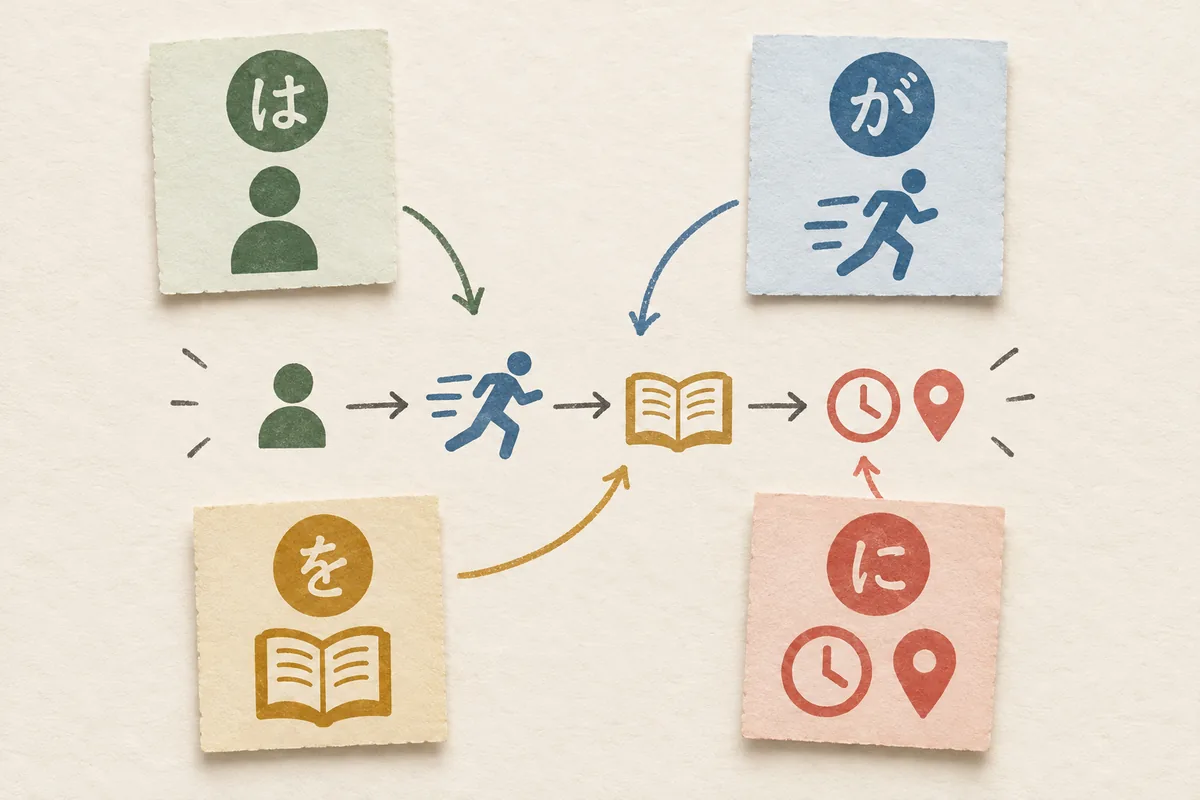
A simple practice route for Japanese particles
Memorizing a chart is useful, but recall improves when you make small decisions. Use this four-step routine for ten minutes a day:
- Start with one role. Practise を with five actions such as 食べる, 飲む, 読む, 見る, and 買う. Keep the object visible in each sentence.
- Change one particle. Write a pair such as 公園に行きます and 公園で遊びます. Say what changed: destination versus action location.
- Read aloud and shadow. Use the kana and romaji in a resource such as Japanese phrases for beginners, then repeat the full rhythm rather than pausing after every particle.
- Review in context. Add new examples to your vocabulary notes. Basic Japanese words and hiragana reading practice give you short nouns and verbs to combine.
For a quick game-like review, use Kotobade Asobou to recall kana and short Japanese words, or check the Japanese learning games guide for other low-pressure practice ideas. The goal is not to guess a single “correct translation” for every particle. The goal is to recognise the relationship quickly when you meet a new sentence.
FAQ
What are Japanese particles?
Japanese particles are short words placed after nouns or phrases to show roles such as topic, subject, object, destination, location, possession, and connection. They help listeners follow a flexible Japanese sentence.
What is the difference between は and が?
は sets a topic or contrast, while が identifies or highlights a subject, often as new information. Context decides which sounds natural, so learn both inside complete sentences.
When should I use に instead of で?
Use に for a destination, a time point, a recipient, or a place where something exists. Use で for the location of an action or the means used to do it.
Do Japanese particles have one English translation?
No. A particle marks a grammatical relationship, and the most natural English wording changes with the sentence. Role and context are more useful than a fixed one-word gloss.
How can beginners practise Japanese particles?
Choose one particle role, write five short examples, then make pairs that change only the particle. Read them aloud and explain the difference in plain English.
Summary
Begin with は, が, を, に, and で, but learn each one as a relationship rather than a translation. は frames the topic, が focuses a subject, を marks an object, に points to a destination or time, and で shows where or how an action happens. Add の, と, も, へ, から, and まで as your examples grow. Short, repeated sentences will make the choices feel natural much faster than a chart alone.
For broader beginner study, continue with Japanese numbers, Japanese days of the week, and the hiragana chart. Each page supplies concrete vocabulary you can reuse in your own particle examples.