Japanese Numbers: 1–100, Counters, and Easy Practice
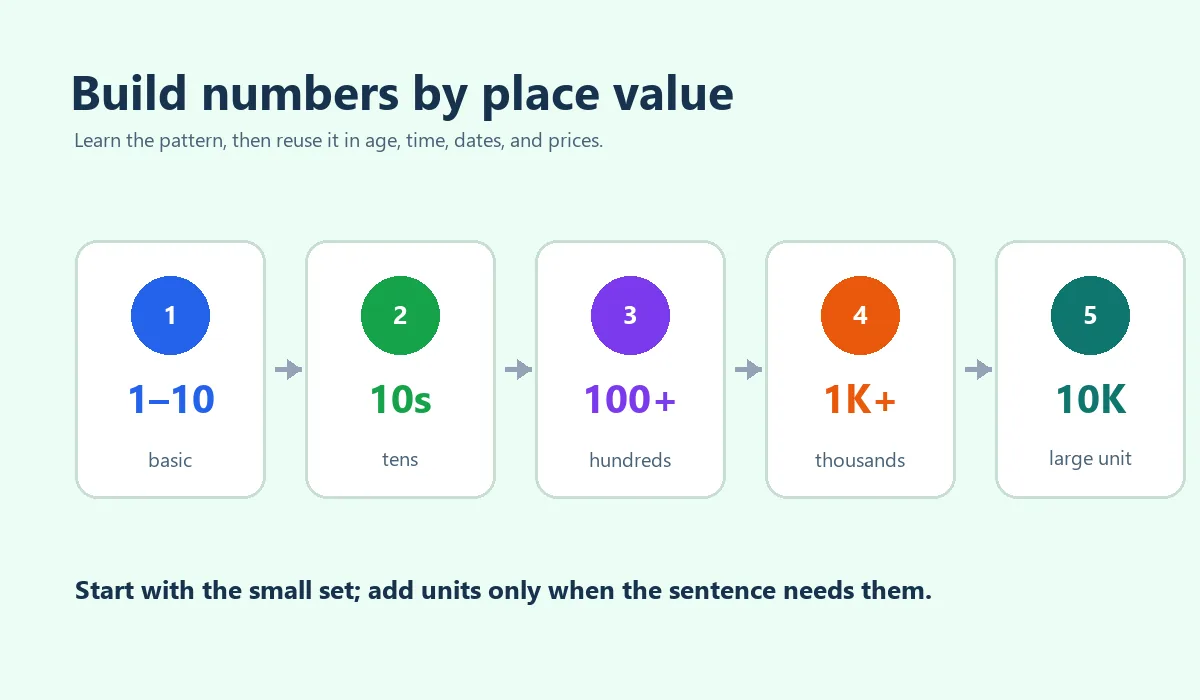
Japanese numbers become much easier when you learn the building pattern instead of trying to memorize a long list. Start with 1–10, combine a tens word with a single digit for 11–99, then add the large units 百 (100), 千 (1,000), and 万 (10,000). This guide gives you kana, romaji, kanji, practical counters, and short examples for everyday Japanese.
What are Japanese numbers?
Japanese numbers can appear as kanji, kana, or Arabic numerals. A textbook may show 一, a learner-friendly guide may write いち, and a modern schedule may simply use 1. These are not three different number systems to memorize. They are different writing choices for the same vocabulary. The useful beginner habit is to recognize the kanji, read the kana, and understand the Arabic form when you see it in real life.
The main cardinal numbers are the foundation. Counting objects, telling your age, reading a price, giving a date, and describing a time all begin with this core set. The pronunciation can change when a number joins a counter, so learn the general form first and treat counter-specific changes as a second step.
Japanese numbers 1–10
This is the table to review until you can recognize each entry without translating through English. The common beginner choices use yon for four, nana for seven, and kyuu for nine. Shi, shichi, and ku are also real readings, but the alternatives are easier to handle after the basic pattern is familiar.
| Number | Kanji | Kana | Romaji | Note |
|---|---|---|---|---|
| 0 | 零 / 〇 | れい / ゼロ | rei / zero | Zero depends on context. |
| 1 | 一 | いち | ichi | Basic counting form. |
| 2 | 二 | に | ni | Basic counting form. |
| 3 | 三 | さん | san | Basic counting form. |
| 4 | 四 | よん | yon | Shi also appears in some combinations. |
| 5 | 五 | ご | go | Basic counting form. |
| 6 | 六 | ろく | roku | Basic counting form. |
| 7 | 七 | なな | nana | Shichi is another common reading. |
| 8 | 八 | はち | hachi | Basic counting form. |
| 9 | 九 | きゅう | kyuu | Ku appears in some set phrases. |
| 10 | 十 | じゅう | juu | The base for the tens pattern. |
Japanese numbers 1–100: the pattern
From 11 to 99, Japanese usually places the tens number before 十 (juu), then adds the final digit. For example, 21 is 二十一: ni-juu-ichi. You do not need a unique word for every number. Once you know 1–10 and the tens, you can build most two-digit numbers on the spot.
| Number | Kanji | Kana | Romaji |
|---|---|---|---|
| 10 | 十 | じゅう | juu |
| 20 | 二十 | にじゅう | nijuu |
| 30 | 三十 | さんじゅう | sanjuu |
| 40 | 四十 | よんじゅう | yonjuu |
| 50 | 五十 | ごじゅう | gojuu |
| 60 | 六十 | ろくじゅう | rokujuu |
| 70 | 七十 | ななじゅう | nanajuu |
| 80 | 八十 | はちじゅう | hachijuu |
| 90 | 九十 | きゅうじゅう | kyuujuu |
| 100 | 百 | ひゃく | hyaku |
100, 1,000, and 10,000 in Japanese
Large numbers use units, but the grouping feels different from English because 万 (man) is a major unit at 10,000. Learn the units as landmarks rather than translating each character one by one. The irregular sound changes in the hundreds and thousands are common enough to deserve their own short review list.
| Number | Kanji | Kana | Romaji | Example |
|---|---|---|---|---|
| 100 | 百 | ひゃく | hyaku | 100円 = hyaku en |
| 300 | 三百 | さんびゃく | sanbyaku | Sound changes from hyaku. |
| 600 | 六百 | ろっぴゃく | roppyaku | Small っ marks the pause. |
| 800 | 八百 | はっぴゃく | happyaku | Another common change. |
| 1,000 | 千 | せん | sen | Often just sen for 1,000. |
| 3,000 | 三千 | さんぜん | sanzen | Sound changes from sen. |
| 8,000 | 八千 | はっせん | hassen | Small っ marks the pause. |
| 10,000 | 一万 | いちまん | ichiman | 万 is man, not a direct 10-thousand word in English. |
Japanese counters: why the reading changes
Japanese often uses a counter after a number to show what is being counted. English can say “three books” with the same number word used for many nouns. Japanese attaches a counter such as 冊 for books, 人 for people, or 本 for long objects. The counter can change the sound of the number, which is why a learner may hear a form that does not look like the table above.
| What you count | Counter | Example | Meaning |
|---|---|---|---|
| People | 人 (にん / nin) | 三人 (さんにん / sannin) | three people |
| Small general items | 個 (こ / ko) | 二個 (にこ / niko) | two small items |
| Long objects | 本 (ほん / hon) | 三本 (さんぼん / sanbon) | three long objects |
| Flat objects | 枚 (まい / mai) | 四枚 (よんまい / yonmai) | four flat items |
| Age | 歳 (さい / sai) | 五歳 (ごさい / gosai) | five years old |
| Time on a clock | 時 (じ / ji) | 三時 (さんじ / sanji) | 3 o'clock |
Use Japanese numbers in real beginner sentences
A number becomes easier to remember when it answers a real question. Practice the same number in different settings so your memory connects the sound to a situation, not only to a flashcard. These examples are intentionally short and can be read after you review the hiragana chart.
Notice that 20 years old is commonly expressed with はたち (hatachi), a special everyday word, rather than only the regular number plus 歳. This is a good example of the order to follow: learn the regular pattern first, then collect high-frequency exceptions as complete phrases.
How to memorize Japanese numbers
The most efficient beginner routine is short and repeated. A long session can make the list feel familiar without making recall faster. Use a seven-minute review that moves from recognition to production:
- Read 0–10 in kana, then say the romaji only to check yourself.
- Cover the English column and recall the meaning from the Japanese form.
- Build five random two-digit numbers, such as 24, 37, 58, 61, and 92.
- Read one price, one age, one clock time, and one people-count example aloud.
- Review the irregular forms for 300, 600, 800, 3,000, and 8,000.
- Return the next day and test yesterday’s words before adding anything new.
If you are still learning the script, keep the basic Japanese words guide nearby for vocabulary context and use the Japanese phrases guide to turn numbers into short requests and descriptions. A compact word game such as Kotobade Asobou can then help you recall kana shapes under a time or guess constraint, but it should support—not replace—your pronunciation and grammar practice.
When numbers appear beside a calendar date, continue with the Japanese days of the week guide to connect dates with weekday names and natural schedule sentences.
Common mistakes with numbers in Japanese
Memorizing romaji without kana
Romaji is useful as a bridge, but numbers quickly appear in kana, kanji, menus, schedules, and subtitles. Read いち before looking at “ichi” whenever possible. The hiragana words guide can help you move from isolated characters to short vocabulary.
Assuming every counter is regular
Counters create sound changes and special forms. Do not treat sanbyaku, roppyaku, happyaku, or hassen as mistakes simply because they do not look like a clean concatenation. Learn them as complete high-frequency forms and listen for the small pause marked by っ in kana.
Using one reading everywhere
Yon and nana are friendly beginner defaults, but you will meet shi and shichi in words, dates, counters, or fixed expressions. The goal is not to choose one reading forever. The goal is to recognize the common alternatives and learn them in context rather than freezing when a familiar number sounds different.
FAQ
How do you say the numbers 1 to 10 in Japanese?
The common beginner readings are ichi, ni, san, yon, go, roku, nana, hachi, kyuu, and juu. Four, seven, and nine also have alternate readings that appear with some counters or in set expressions.
How do you say 100 in Japanese?
100 is 百, read hyaku. The hundreds change sound in common forms such as sanbyaku (300), roppyaku (600), and happyaku (800), so practice those as complete words.
Should I use yon or shi for four?
Yon is a safe beginner default for ordinary counting. Shi is also a real reading and appears in some words and counter combinations. Learn both gradually, starting with the form used in your current example.
Do Japanese numbers use kanji, kana, or Arabic numerals?
All three appear. Learn to connect 一 with いち and 1, 十 with じゅう and 10, and so on. This makes menus, schedules, prices, and learning materials easier to read.
What is the fastest way to memorize Japanese numbers?
Learn 1–10 first, build 11–99 with the tens pattern, then add 100, 1,000, and 10,000. Practice those forms inside age, time, date, price, and counter examples instead of reviewing a disconnected list.
Summary
Japanese numbers are a pattern system with a small core vocabulary. Begin with 0–10, build two-digit numbers from the tens, and then add 百, 千, and 万. Keep kana, romaji, kanji, and Arabic numerals connected so that you can recognize the same number in different formats.
Once the foundation feels comfortable, add counters for people, objects, age, and time. Expect a few sound changes, especially in the hundreds and thousands, and treat them as useful phrases rather than exceptions that make the whole system unpredictable.
Practice Japanese word recall
After reviewing the numbers, practice Japanese word shapes and kana recall with a short daily game. The compact board on Kotobade Asobou gives you a practical way to keep vocabulary review active.
Play Kotobade AsobouSources and further reading
For additional reference on Japanese numerals and counter words, see the Japanese numerals overview and the Japanese counter word overview. This guide reorganizes the core patterns around beginner reading, real-life examples, and spaced practice.