Japanese Days of the Week: Names, Kanji, and Easy Mnemonics
The Japanese days of the week are easier than they first appear. Each name combines one kanji clue—sun, moon, fire, water, tree, gold, or earth—with the shared ending 曜日 (ようび, youbi). This guide gives you the days of the week in Japanese, clear kana and romaji, pronunciation notes, useful sentence patterns, and a memory route that turns seven separate words into one sequence.
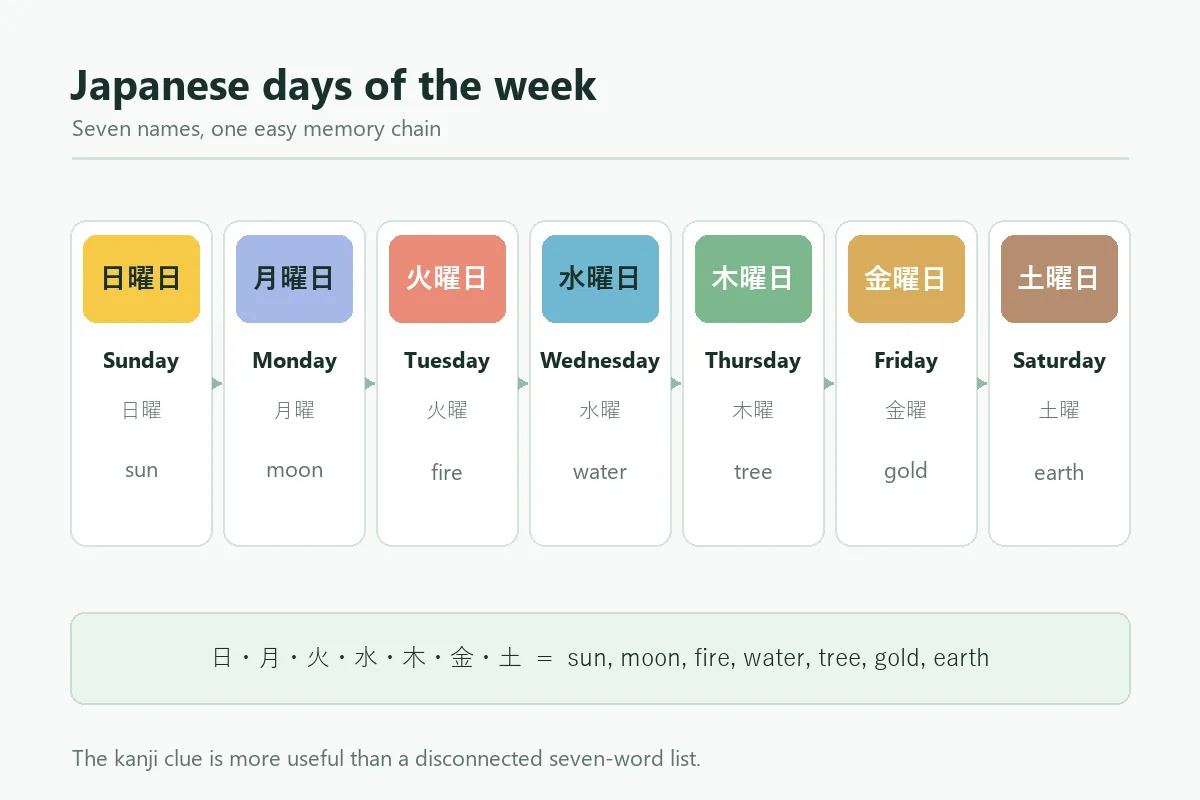
Japanese days of the week: the reference table
The table below is the core reference for Japanese weekdays. The Japanese spelling uses kanji, the kana line shows how to read it, and the romaji is only a pronunciation aid. Try to move from romaji to kana quickly: kana makes long vowels and the small っ or ん easier to notice when you encounter calendars, schedules, or messages written in Japanese.
| English | Kanji | Hiragana | Romaji | Memory clue |
|---|---|---|---|---|
| Sunday | 日曜日 | にちようび | nichiyoubi | 日 = sun |
| Monday | 月曜日 | げつようび | getsuyoubi | 月 = moon |
| Tuesday | 火曜日 | かようび | kayoubi | 火 = fire |
| Wednesday | 水曜日 | すいようび | suiyoubi | 水 = water |
| Thursday | 木曜日 | もくようび | mokuyoubi | 木 = tree |
| Friday | 金曜日 | きんようび | kinyoubi | 金 = gold or metal |
| Saturday | 土曜日 | どようび | doyoubi | 土 = earth or soil |
A compact calendar may remove the final 日 and show only 日曜, 月曜, 火曜, 水曜, 木曜, 金曜, and 土曜. These shorter forms still refer to the same days. You may also see the kanji alone in a small calendar column, especially when there is not enough space for the full word.
The shared ようび pattern
曜日 (ようび, youbi) means “day of the week.” The first kanji supplies the traditional element clue, and 曜日 tells you that the whole expression is a weekday name. This structure is useful because it gives you a fixed part to recognize. Instead of memorizing seven long spellings, learn seven short element names and one common ending.
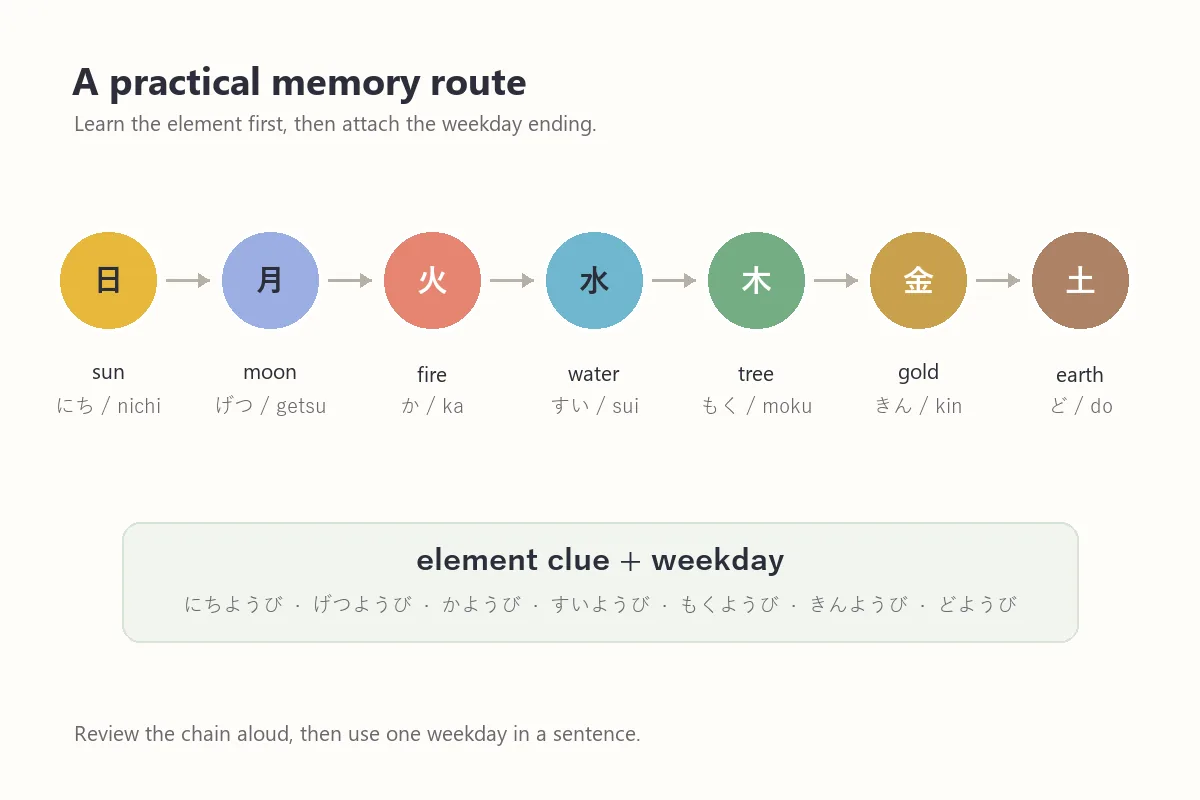
The pronunciation is not perfectly identical in every position. Sunday begins with にち, Monday with げつ, Tuesday with か, Wednesday with すい, Thursday with もく, Friday with きん, and Saturday with ど. The ending ようび is stable. Say each word in two beats at first: げつ・ようび, すい・ようび, きん・ようび. Later, let the natural rhythm become smoother.
Use Japanese weekdays in everyday sentences
Knowing the list is useful, but sentence patterns make the words stick. When a specific weekday is the time of an action, に (ni) is a common particle: 月曜日に勉強します means “I study on Monday.” When the weekday is the topic of a description, は (wa) is natural: 金曜日は忙しいです means “Friday is busy.” These patterns also prepare you for dates and appointments, where a weekday often appears beside a number and a month.
In a question, 何曜日 (なんようび, nan youbi) means “what day of the week?” For example, 今日は何曜日ですか (Kyou wa nan youbi desu ka) asks, “What day is it today?” The answer can be short: 今日は木曜日です (Kyou wa mokuyoubi desu), “Today is Thursday.” Notice the difference between 何曜日, which asks for a weekday, and 何日 (なんにち), which asks for the day of the month or a calendar date.
How to remember the Japanese days of the week
The best mnemonic is the order of the first kanji: 日月火水木金土. Read it as sun, moon, fire, water, tree, gold, earth. This sequence comes from the traditional association of the weekdays with the sun, moon, and five classical elements. You do not need to study the history in depth to use the memory clue; the visual meaning of each kanji is enough for a beginner review routine.
- Read the seven kanji aloud without the full weekday names: 日、月、火、水、木、金、土.
- Add the shared ending and say the full words: にちようび through どようび.
- Cover the English column and recall the meaning from the kanji.
- Write one simple sentence with に or は for two different weekdays.
- Review the sequence again the next day, then use it in a real calendar or schedule.
A helpful rhythm is to group the list into three pairs plus one: 日月, 火水, 木金, 土. The pairs are not grammar rules; they are simply a memory shape that reduces the feeling of seven unrelated items. Another option is to imagine a small weekly scene: the sun rises, the moon appears, fire burns, water flows, a tree grows, gold shines, and earth remains under your feet. Choose the image that you can recall quickly rather than the mnemonic that sounds most clever.
Common mistakes and a short practice plan
Do not rely on romaji forever
Romaji is useful when you first meet a word, but it can hide the difference between long vowel sounds and separate syllables. In ようび, the よう sound is long, so you will often see youbi in learner materials even though the spoken sound is closer to “yoh-bi.” Read the kana in this hiragana chart and compare the long vowel pattern with other beginner words.
Do not confuse げつようび and きんようび
Monday and Friday are frequent in schedules, so they are worth extra practice. 月曜日 starts with げつ, while 金曜日 starts with きん. The kanji clues help: moon for Monday and gold or metal for Friday. If you are learning through listening, repeat the first syllable clearly before saying ようび.
Use a seven-day review loop
On day one, learn the table. On day two, write the kanji order from memory. On day three, answer 何曜日ですか with three different weekdays. On day four, read a short calendar. On day five, make sentences with に, は, まで, and から. On days six and seven, review without looking at romaji. This short loop is more effective than copying the list many times in one sitting because it moves from recognition to recall and then to use.
FAQ about Japanese weekdays
What are the days of the week in Japanese?
Sunday is 日曜日 (にちようび, nichiyoubi), Monday is 月曜日 (げつようび, getsuyoubi), Tuesday is 火曜日 (かようび, kayoubi), Wednesday is 水曜日 (すいようび, suiyoubi), Thursday is 木曜日 (もくようび, mokuyoubi), Friday is 金曜日 (きんようび, kinyoubi), and Saturday is 土曜日 (どようび, doyoubi).
How do you say Monday in Japanese?
Monday is 月曜日, read げつようび (getsuyoubi). On a compact calendar, the shorter label 月曜 is also common.
What does 曜日 mean?
曜日 (ようび, youbi) means “day of the week.” Put it after the element kanji to form a complete weekday name.
What is the fastest way to memorize Japanese weekdays?
Memorize 日月火水木金土 as sun, moon, fire, water, tree, gold, earth. Then attach ようび and practice one sentence per day.
How do I ask what day it is in Japanese?
今日は何曜日ですか (Kyou wa nan youbi desu ka) means “What day of the week is it today?” Answer with 今日 は plus a weekday, such as 今日は水曜日です.
Summary
The Japanese days of the week are a compact system: seven element kanji plus the shared ending 曜日. Start with the table, then remember 日月火水木金土 as sun, moon, fire, water, tree, gold, and earth. Use に for a scheduled action, は for a weekday topic, and 何曜日 to ask which weekday it is. Once these words feel familiar, connect them with common Japanese phrases, hiragana reading practice, and real calendars so the vocabulary becomes part of your everyday reading.
Further reading
- Tofugu: Japanese Days of the Week — additional pronunciation and mnemonic context.
- Japan Foundation Japanese-language resources — first-party learning materials and study resources.
Use a short daily review to connect kana, vocabulary, and recall.
Play today’s Japanese word game