Hiragana Reading Practice: Simple Words, Short Exercises, and Answers
Hiragana reading practice becomes easier when you stop treating kana as isolated symbols. Start with a small group, join the symbols into short words, and then read one short sentence without reaching for romaji after every character. This guide gives you that route with examples, answer checks, confusing-pair practice, and a seven-day routine.

What hiragana reading practice actually trains
A hiragana quiz and hiragana reading practice are related, but they are not the same task. A quiz may show ね and ask you to choose “ne.” Reading practice asks you to combine ね and こ, say ねこ, and connect the word to “cat.” The second task is closer to what you need when reading a beginner lesson, a caption, a menu, or a short message.
The goal is not to hide every aid immediately. It is to move the aid to the right place: use a chart while learning a row, use romaji to check a difficult answer, and use English meaning only after you have tried to read the Japanese first. That order gives your eyes more practice with the script.
| Stage | What you do | Pass condition |
|---|---|---|
| Symbol | Recognise a small kana group. | You can say the sound without guessing from shape alone. |
| Word | Join two to five kana in sequence. | You read the whole word before checking romaji. |
| Pattern | Handle voiced marks, small kana, and pauses. | You do not add an extra beat for every visible symbol. |
| Sentence | Read a short beginner sentence. | You can repeat the meaning after reading the kana. |
Use a four-stage hiragana reading ladder
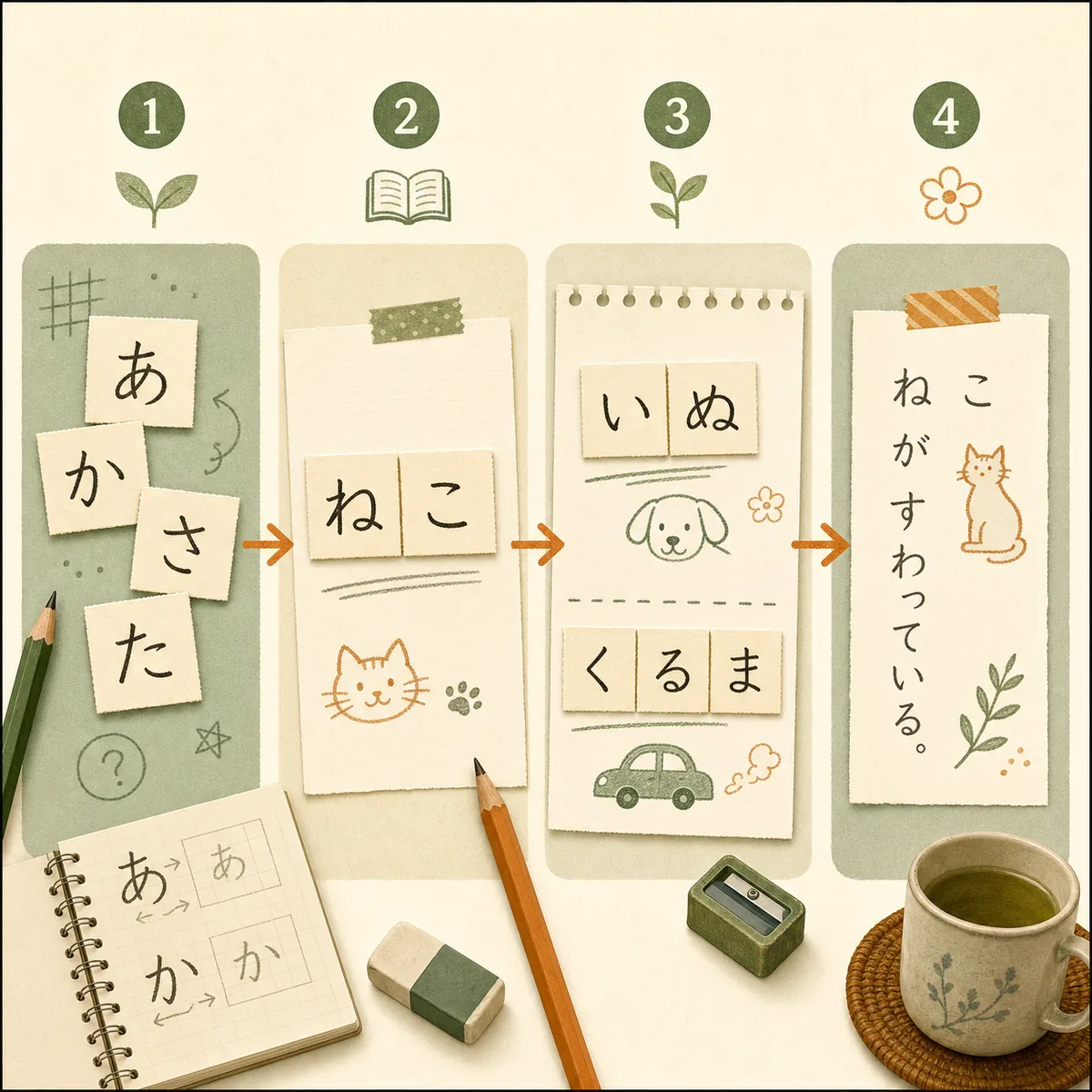
Spend most of your session at the stage that feels just slightly difficult. If every item is automatic, add a longer word or a small kana pattern. If every item feels impossible, return to a smaller group and remove the romaji until the basic shapes are familiar again.
Start with short hiragana words
Short words are the bridge between a chart and real reading. Read the kana column first. Cover the romaji and meaning if you are studying on screen, or fold the page so the answer is hidden. Then say the word once more after checking the meaning.
| Hiragana | Romaji check | Meaning | Reading note |
|---|---|---|---|
| ねこ | neko | cat | Two familiar kana; read them as one word. |
| いぬ | inu | dog | Useful contrast between い and ぬ. |
| いえ | ie | house | The vowels sit next to each other; do not merge them. |
| みず | mizu | water | ず includes a dakuten mark; notice the sound change. |
| やま | yama | mountain | A clear two-syllable rhythm for early reading. |
| はな | hana | flower / nose | Meaning depends on context, so keep both possibilities in mind. |
| さくら | sakura | cherry blossom | A longer word that still uses familiar basic kana. |
| ことば | kotoba | word / language | ば has dakuten; read the mark rather than skipping it. |
| たべる | taberu | to eat | Use it as a first verb example, not just a noun list. |
| すき | suki | like / favourite | The final き is easy to confuse with similar shapes. |
Read the patterns that slow beginners down
Beginners often know the basic chart but lose confidence when the word contains a mark or a small kana. Treat these as reading patterns, not as a second giant chart. Meet each pattern in a few useful words and then return to ordinary vocabulary.
| Pattern | Example | How to read it | Common mistake |
|---|---|---|---|
| Dakuten | か → が, さ → ざ | The mark changes the consonant sound. | Reading ば as は or ignoring the two small strokes. |
| Handakuten | は → ぱ | The small circle creates a p sound. | Confusing ぱ with は when reading quickly. |
| Small ゃ・ゅ・ょ | きゃ, しゅ, ちょ | Read the pair as one combined sound. | Giving the small kana a full extra beat. |
| Small っ | きって, さっき | Make a short pause or doubled consonant. | Reading っ as the full sound “tsu.” |
| Particles | は, へ, を | In common grammar roles they are often read wa, e, and o. | Using only the chart pronunciation without checking the sentence role. |
| Long vowel | おばあさん | Keep the extended vowel in the rhythm. | Compressing every kana into a short English-style syllable. |
You do not need to master every exception before reading. Add one pattern at a time, keep the example in a short word, and say it aloud. If your main goal is handwriting, the hiragana chart has a separate stroke-order section; this page keeps the focus on recognising the sequence while reading.
Try short hiragana reading exercises
The following exercises are deliberately small. Read the Japanese first, pause, and then use the answer column. A correct answer is not only a perfect sound; it is also noticing the word boundary and recalling the basic meaning.
Exercise 1: read the word before the meaning
| Try first | Answer check | Meaning |
|---|---|---|
| くるま | kuruma | car |
| さかな | sakana | fish |
| あさ | asa | morning |
| ふゆ | fuyu | winter |
| でんわ | denwa | telephone |
Exercise 2: read a short beginner sentence
| Japanese | Romaji check | Plain meaning |
|---|---|---|
| これは いぬ です。 | kore wa inu desu | This is a dog. |
| ねこが います。 | neko ga imasu | There is a cat. |
| みずを のみます。 | mizu o nomimasu | I drink water. |
| すしが すきです。 | sushi ga suki desu | I like sushi. |
Fix confusing kana pairs
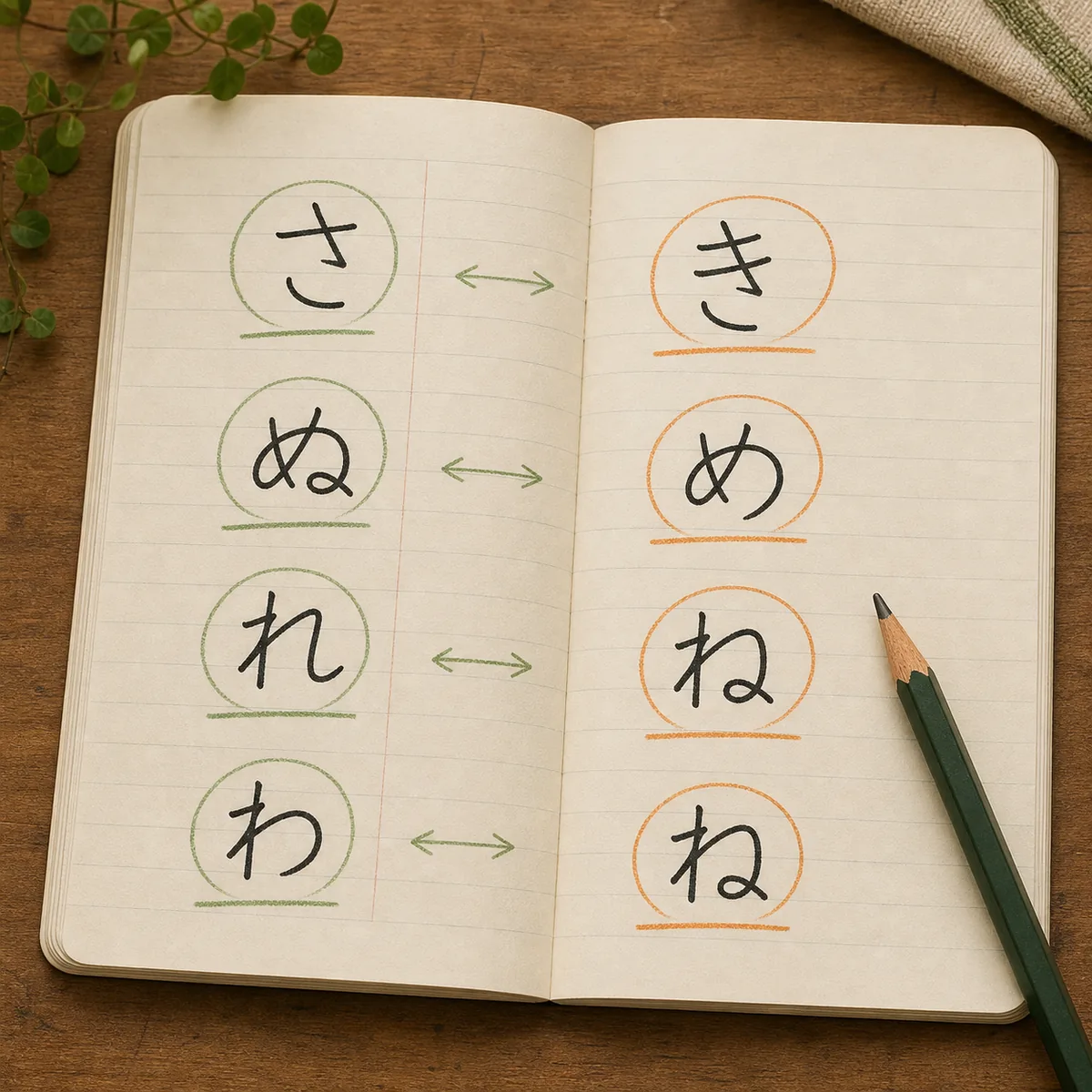
When two hiragana shapes look similar, placing them side by side gives your memory a useful boundary. Do not write one character fifty times without comparison. Write the pair, say both sounds, and then read a word containing each one.
| Pair | Try these words | What to notice |
|---|---|---|
| さ / き | さかな / きく | Compare the opening stroke and the lower shape. |
| ぬ / め | いぬ / め | Look at the loop and where the final stroke closes. |
| れ / ね | れきし / ねこ | Notice the extra loop and the direction of the last stroke. |
| わ / ね | わたし / ねこ | Read the whole word so shape memory has a sound context. |
| は / ほ | はな / ほし | Compare the extra vertical detail in the second character. |
If a pair still feels unstable, add it to tomorrow’s warm-up rather than restarting the whole chart. The hiragana quiz can test single-character recognition, but the word examples above are the step that makes the distinction useful while reading.
Use romaji as a temporary check
Romaji is helpful at the beginning because it tells you whether your sound guess is close. It becomes a problem only when it remains the first thing your eyes search for. A practical three-pass method is:
- Pass one: read the kana slowly and make your best guess.
- Pass two: reveal romaji only if one symbol or pattern stopped you.
- Pass three: hide romaji again and read the complete word from kana to meaning.
Keep romaji beside the answer, not above the Japanese. This small layout choice makes kana the starting point. If you still need a complete word list with romaji and meanings, use the Hiragana Words guide; if you need the full character rows, return to the Hiragana Chart.
Follow a seven-day hiragana reading practice route
A short daily plan is easier to maintain than an enormous worksheet. Keep each session to about ten minutes and stop while you can still read the final item with attention.
| Day | Focus | Small target |
|---|---|---|
| 1 | Basic rows | Review one small kana group and read five two-kana words. |
| 2 | Short nouns | Read ten words such as ねこ, いぬ, みず, and やま without romaji first. |
| 3 | Dakuten | Contrast は/ば/ぱ and さ/ざ in a few words. |
| 4 | Small kana | Read きゃ, しゅ, ちょ, and one word with っ. |
| 5 | Confusing pairs | Choose two pairs, write them side by side, and read two words for each. |
| 6 | Short sentences | Read four sentences, then explain their plain meaning. |
| 7 | Recall check | Hide romaji, read a mixed list, and note the patterns that still slow you down. |
After the week, repeat the route with new words instead of simply increasing the list size. If reading feels comfortable but recognition is slow, use the quiz page as a short warm-up. If you can read kana but want more vocabulary, continue with Basic Japanese Words or practise fixed-length word shapes with four-letter Japanese words.
Which hiragana practice page should you use?
| Your need | Best page | Why |
|---|---|---|
| See every basic row, dakuten, and small kana | Hiragana Chart | Reference tables, handwriting notes, and practice order. |
| Read words with romaji and meanings | Hiragana Words | Vocabulary groups, word length, meanings, and word-game use. |
| Test individual kana quickly | Hiragana Quiz | Short recognition round with immediate answer feedback. |
| Read kana in words and short sentences | This guide | Step-by-step reading practice, answer checks, and a weekly route. |
| Start the second Japanese script | Katakana Chart | Katakana rows, voiced sounds, long vowels, and small ッ. |
FAQ
How long should I practise hiragana reading each day?
Start with about ten focused minutes: review a small group, read five words, and finish with one short sentence. If yesterday’s words are not stable, review them before adding more. Consistency matters more than one long cram session.
Do I need to learn all 46 hiragana before reading words?
No. Learn a small row group, then read words that use those kana. Early word reading gives the symbols a sound and meaning context, which is more useful than memorising a chart once and never using it.
Should beginners use romaji while practising hiragana reading?
Use romaji as a short answer check when you are stuck, then hide it and read from kana to meaning. Depending on romaji for every word slows script recognition, so keep the Japanese column visually first.
What is the difference between hiragana reading practice and a hiragana quiz?
A quiz usually checks whether you can identify an individual symbol and its romaji. Reading practice asks you to combine symbols into words and short sentences, then connect the sequence to meaning. Use both, but do not expect one task to replace the other.
Is hiragana writing practice the same as hiragana reading practice?
No. Writing practice develops stroke direction, proportion, and recall from sound to hand. Reading practice develops quick recognition from written kana to sound and meaning. They support each other, but the exercises should be kept clear.
What should I study after hiragana reading practice?
Keep building kana-first vocabulary, then add simple sentences and compare hiragana with katakana. Use a chart for reference, a quiz for quick recognition checks, and short word games only after the basic reading patterns feel familiar.
Summary
The most useful hiragana reading practice is a small loop: recognise a few kana, read a short word, notice one special pattern, and finish with a sentence. Hide romaji before you read, reveal it only as a check, and return to the Japanese after you confirm the answer.
Use the hiragana chart for reference, the hiragana words guide for vocabulary, and the hiragana quiz for individual-symbol recall. This page fills the space between those resources: it helps you read kana in sequence and attach the sequence to meaning.
Practise short Japanese word shapes
Once you can read a small list of hiragana words, try a short kana-based word game. Kotobade Asobou gives you a compact way to practise Japanese word shapes and daily recall in the browser.
Play Kotobade AsobouSources and further reading
Kana order and basic examples were checked against MARUGOTO Plus from the Japan Foundation, including its hiragana drill. Beginner explanations were compared with Tofugu’s Learn Hiragana guide and Tae Kim’s hiragana explanation. The exercises on this page are original practice examples for reading sequence and meaning; they are not a replacement for pronunciation instruction from a teacher or audio course.