Japanese Counters: How to Count People, Books, Animals, and More
Japanese counters are short words that follow a number and show what is being counted. Use 人 for people, 冊 for books, 本 for long objects, 枚 for flat things, and 匹 for many small animals. The number may also change its sound before a counter, so this guide pairs the most useful categories with readings, examples, and a simple choice method.
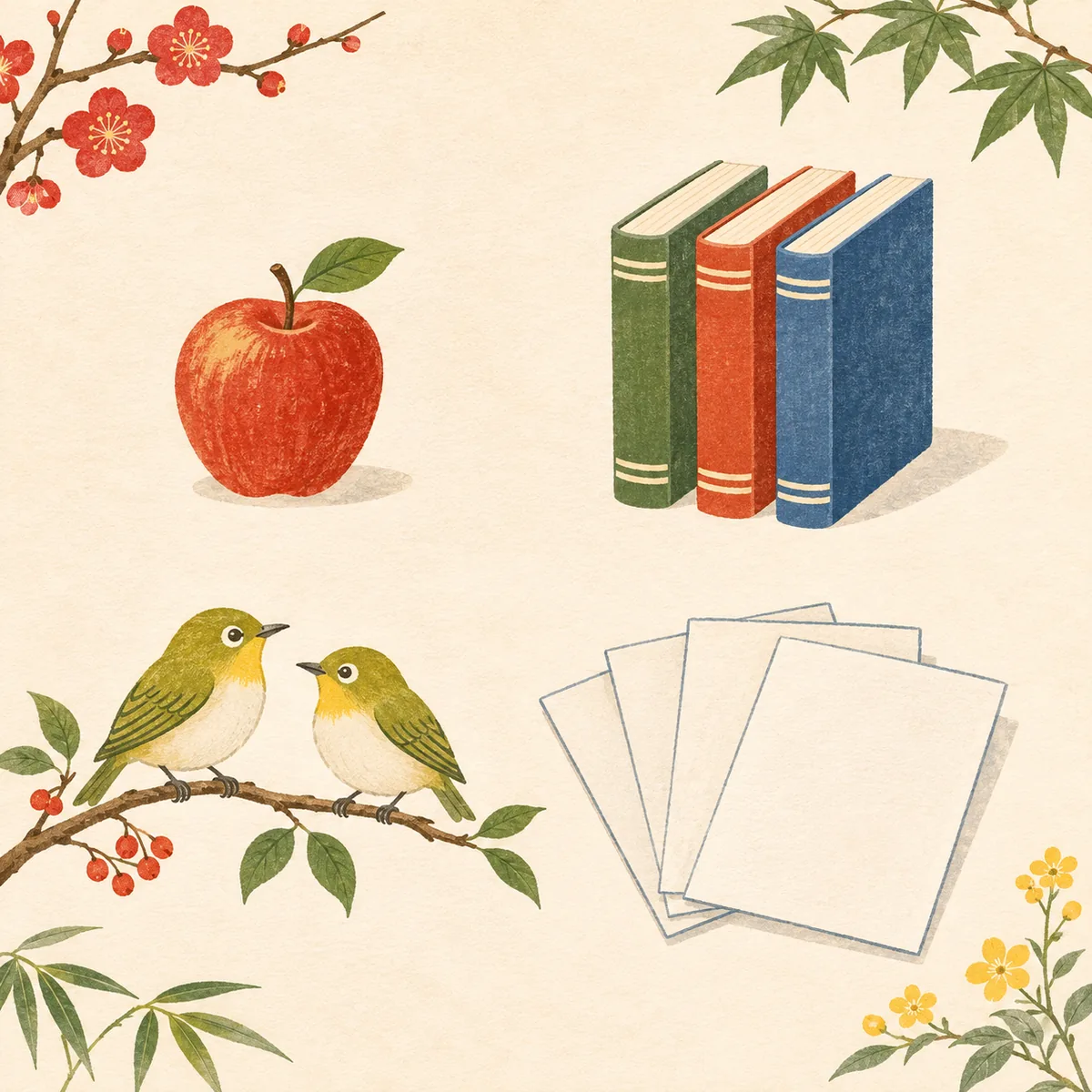
What Japanese counters do
In English, the word “three” stays the same in “three books,” “three people,” and “three bottles.” Japanese usually places a counter after the number to identify the kind of quantity: 三冊 (sansatsu) for three books, 三人 (sannin) for three people, and 三本 (sanbon) for three long objects. The counter is part of the counting phrase, not a plural ending added to the noun.
Think of the counter as a label for the shape or category being counted. You do not need to memorize every counter before speaking. Learn the small group you are likely to use, then add specialized counters when a real situation calls for them. The same object can sometimes be described in more than one way depending on whether you mean individual pieces, a serving, a set, or another practical unit.
Common Japanese counters by object
This quick chart covers everyday choices rather than every counter in Japanese. The readings in the last column are sample forms; a number may have a special pronunciation with that counter.
| What you count | Counter | Common use | Useful forms |
|---|---|---|---|
| General items | つ (tsu) | Broad everyday counts, especially one to ten | ひとつ hitotsu; ふたつ futatsu; みっつ mittsu |
| Small separate items | 個 (ko) | Many individual pieces, fruit, or small objects | 一個 ikko; 二個 niko; 三個 sanko |
| People | 人 (nin) | People in a group or family | 一人 hitori; 二人 futari; 三人 sannin |
| Bound books | 冊 (satsu) | Books, notebooks, and other bound volumes | 一冊 issatsu; 二冊 nisatsu; 三冊 sansatsu |
| Long objects | 本 (hon) | Bottles, pencils, umbrellas, and similar long items | 一本 ippon; 二本 nihon; 三本 sanbon |
| Flat items | 枚 (mai) | Sheets, tickets, plates, or thin flat objects | 一枚 ichimai; 二枚 nimai; 三枚 sanmai |
| Many small animals | 匹 (hiki) | Cats, dogs, fish, and other small animals | 一匹 ippiki; 二匹 nihiki; 三匹 sanbiki |
| Machines and vehicles | 台 (dai) | Cars, computers, and appliances | 一台 ichidai; 二台 nidai; 三台 sandai |
| Cupfuls or glasses | 杯 (hai) | Drinks served or measured by the cup | 一杯 ippai; 二杯 nihai; 三杯 sanbai |
| Floors of a building | 階 (kai) | Floor or story number | 一階 ikkai; 二階 nikai; 七階 nanakai |
The つ counter from one to ten
The つ series is one of the easiest ways to count a general number of things when the exact category is not important. Its first ten forms are special words, so learn them as a set instead of attaching tsu to the usual number reading:
| Number | Japanese | Romaji | Number | Japanese | Romaji |
|---|---|---|---|---|---|
| 1 | 一つ | hitotsu | 6 | 六つ | muttsu |
| 2 | 二つ | futatsu | 7 | 七つ | nanatsu |
| 3 | 三つ | mittsu | 8 | 八つ | yattsu |
| 4 | 四つ | yottsu | 9 | 九つ | kokonotsu |
| 5 | 五つ | itsutsu | 10 | 十 | too |
Use つ for a general number of pieces, tasks, or other countable things when a more precise category is unnecessary. It is not a substitute for every counter: people are counted with 人, age commonly uses 歳, clock time uses 時, and days of the month have their own readings. At a shop, a specific counter can sound clearer than a broad one.
Counting people: 人 has two special forms
For people, the counter is 人, usually read nin. The first two counts are exceptions to the simple number-plus-nin pattern: one person is 一人 (hitori), and two people are 二人 (futari). From three onward, the regular pattern is easier to see. For example, a family of three is 家族は三人です (kazoku wa sannin desu).
| Number of people | Japanese | Romaji |
|---|---|---|
| 1 | 一人 | hitori |
| 2 | 二人 | futari |
| 3 | 三人 | sannin |
| 4 | 四人 | yonin |
| 5 | 五人 | gonin |
| 6 | 六人 | rokunin |
| 7 | 七人 | nananin or shichinin |
| 8 | 八人 | hachinin |
| 9 | 九人 | kyuunin |
| 10 | 十人 | juunin |
Why Japanese counter readings change
Some combinations are adjusted to make them easier to say. A small っ (sokuon) creates a brief stop before the next consonant, as in ippon. In other combinations, an initial h sound becomes b, as in sanbon. Learn common number-counter pairs as complete forms rather than forcing one sound rule onto every counter.
| Counter | Examples to learn together | What to notice |
|---|---|---|
| 本 (long objects) | 一 いっぽん ippon; 二 にほん nihon; 三 さんぼん sanbon | One has a small stop; three has a voiced b sound. |
| 匹 (small animals) | 一 いっぴき ippiki; 二 にひき nihiki; 三 さんびき sanbiki | The same broad pattern appears with p and b sounds. |
| 冊 (books) | 一 いっさつ issatsu; 八 はっさつ hassatsu; 十 じゅっさつ jussatsu | Notice the doubled consonant in common forms. |
| 杯 (cupfuls) | 一 いっぱい ippai; 三 さんばい sanbai; 六 ろっぱい roppai | Some counts use p; others use b or the regular h sound. |
Start by comparing one, two, and three for the same counter. Add the combinations you need instead of memorizing rare forms before the common ones.
Use a counter in a natural sentence
A common pattern places the counted noun and particle before the number-counter phrase. These beginner examples show the meaning of each counter in a sentence:
りんごを二個買いました。 Ringo o niko kaimashita. “I bought two apples.” 個 counts the separate pieces.
本を三冊読みました。 Hon o sansatsu yomimashita. “I read three books.” Bound books use 冊.
水を一本ください。 Mizu o ippon kudasai. “One bottle of water, please.” 本 counts the long bottle, not the water itself.
猫が二匹います。 Neko ga nihiki imasu. “There are two cats.” 匹 is common for small animals.
紙を五枚使いました。 Kami o gomai tsukaimashita. “I used five sheets of paper.” 枚 counts flat items.
You can also place the number-counter phrase before a noun with の: 三冊の本 (sansatsu no hon), “three books.” To ask how many, say 何人 (nan-nin) for people, 何冊 (nan-satsu) for books, 何本 (nan-bon) for long items, or 何個 (nan-ko) for small objects. The counter in the question should match the answer you expect.
A simple way to choose the right counter
- Name the thing you are counting, not only its English translation.
- Ask what matters about the count: people, a bound volume, a long object, a flat item, or an individual piece.
- Choose the common counter from the chart. If you are unsure and the count is general, つ may work for one to ten.
- Check the number's reading with that counter. Start with one, two, and three because common sound changes often show up there.
- Say a short sentence aloud, then keep the counter together with the example in your notes.
For pencils, choose the long-object counter and say 三本 (sanbon). For notebooks, choose the bound-volume counter and say 三冊 (sansatsu). Decide the category first to recall the right reading.
Common mistakes with Japanese counters
Using one counter for every noun
個 is useful for many small separate items, but it is not a universal replacement for every counter. Use 人 for people and 冊 for bound books in ordinary beginner examples. A more specific counter also makes questions and answers easier to understand.
Mixing up 本 and 冊
The kanji 本 also appears in the word for book, but as a counter 本 is used for long objects such as bottles, pencils, and umbrellas. Count bound books with 冊. The object class, not an isolated kanji translation, tells you which counter to choose.
Reading each part mechanically
Forms such as ippon, sanbon, ippiki, and issatsu are normal counter readings. Repeating the number and counter together is a better practice habit than trying to force the base number reading into every combination.
FAQ
How do I know which Japanese counter to use?
Choose the counter that matches the object class: 人 for people, 冊 for bound books, 本 for long cylindrical objects, 枚 for flat items, and 匹 for many small animals. Use a common general form such as つ or 個 only when it fits the situation.
What is the general counter for things in Japanese?
The native つ series is useful for general counts from one to ten when the exact object class is not the focus. 個 also counts many separate small items, but it is not universal.
Why do Japanese counter readings change?
Some number-and-counter combinations use sound changes for natural pronunciation. For example, 一本 is ippon and 三本 is sanbon; learn common combinations as complete forms.
Is 本 the counter for books?
Books are usually counted with 冊, as in 一冊 (issatsu). 本 is the counter for long objects such as bottles, pencils, and umbrellas, even though the kanji 本 also means book in other contexts.
Do Japanese nouns have plural forms?
Japanese nouns often do not need a plural ending. A counter after the number makes the quantity and object class clear when a count matters.
Keep a small counter set first
Start with 人, 個, つ, 冊, 本, and 枚. Add 匹, 台, 杯, or other counters when they match something you actually read, order, or talk about. Keep one noun, number, counter, and sentence together in your practice notes. That gives you a usable phrase instead of an isolated rule.
If you are still building your number vocabulary, continue with the Japanese numbers guide for kana, kanji, and number patterns. Return here when you are ready to connect those numbers to the objects in a sentence.
Further reading
For additional counter examples, compare Kanshudo's basic Japanese counters and the category overview from JLPT-Dojo. This guide focuses on a practical beginner set rather than an exhaustive list.