Japanese Wordle: How to Play, Read Kana, and Improve Your Guesses
Looking for Japanese Wordle? The basic idea is familiar: enter a valid Japanese word, read the colored feedback, and narrow the answer in a limited number of guesses. The important difference is the writing system. Many boards use hiragana or another kana-based input, so a strong approach combines word-game logic with kana reading instead of treating Japanese as an English alphabet with different vocabulary.

What is Japanese Wordle?
Japanese Wordle is a broad description for Wordle-style puzzles built around Japanese words. Some games use a four-character answer, some use five, and some count kana or sound units in their own way. That means the phrase “wordle Japanese” does not identify one universal ruleset. Before making a guess, look at the board length, the accepted script, and the explanation shown by the game.
For learners, the most useful version is one that keeps the task visible: read a word in kana, submit it, and use the feedback to make the next choice. You do not need to know every kanji to begin. You do need a reliable way to recognize hiragana, distinguish similar sounds, and notice whether a small kana or long-vowel mark changes the accepted input.
What stays familiar
You still get a limited number of attempts, feedback after each valid guess, and a deduction problem. Confirmed positions become anchors while misplaced characters become movable clues.
What changes
The answer may be displayed or entered in kana, and the dictionary may include forms that feel unfamiliar to English learners. Character-count rules also depend on the particular board.
How to play Japanese Wordle with kana clues
The fastest way to learn is to treat the first round as a controlled experiment. Do not try to solve the answer from one lucky word. Use a valid entry, record what the colors say, and let the next guess remove possibilities.
- Check the format: confirm whether the board expects four or five characters and whether it accepts hiragana, katakana, kanji, or a specific combination.
- Enter a familiar word: choose a word you can read confidently. A valid common word gives you useful information without adding spelling uncertainty.
- Read each tile: keep a green character in place, move a yellow character to a new position, and stop using a gray character unless the game has a duplicate-character rule that changes the meaning.
- Test one idea at a time: make the next guess answer a question, such as whether a vowel is in a different position or whether a kana pair is part of the answer.
- Confirm the exact form: if the word is written with kanji in a dictionary, check the kana reading that the puzzle actually accepts before submitting it.
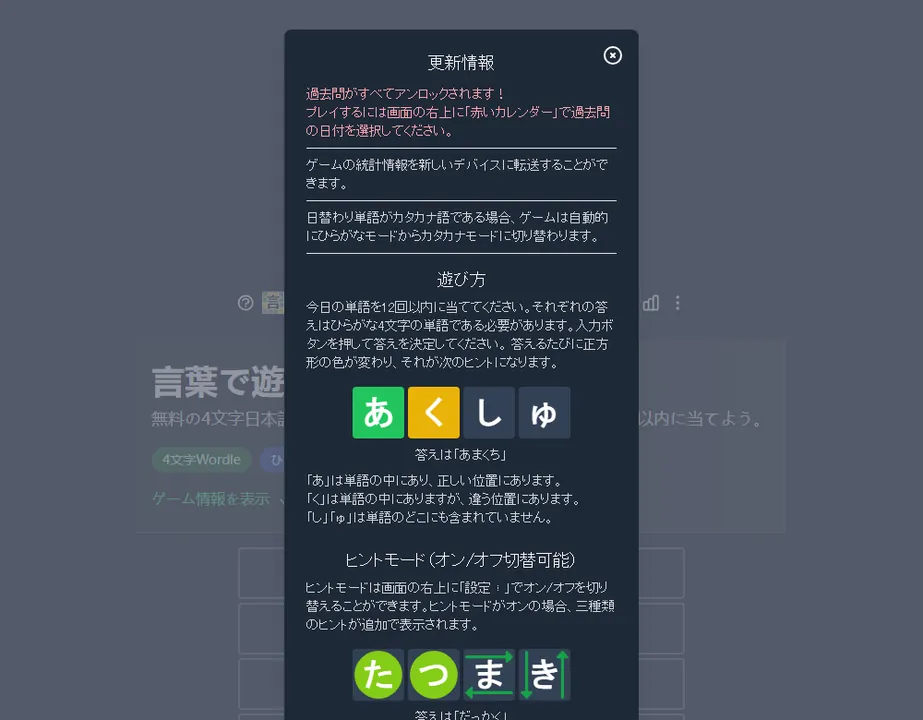
| Feedback | What it usually means | Your next move |
|---|---|---|
| Green | The character is correct and in the correct position. | Keep it fixed while testing the remaining positions. |
| Yellow | The character appears in the answer but not in that position. | Move it and avoid spending the next guess on the same placement. |
| Gray | The character is not part of the answer under the board's rules. | Remove it from your candidate list, while watching for duplicate rules. |
Kana, romaji, and Japanese Wordle character count
Romaji is useful for pronunciation notes, but it can make a Japanese Wordle board look more complicated than it is. A single Japanese sound may be represented by several Latin letters, while a small kana changes the written form without behaving like a full-sized syllable in every counting system. For that reason, count and enter the representation used by the board rather than converting everything into English letters.
Start with the hiragana chart if you are still learning the basic rows. Then practice short words aloud with the hiragana reading practice guide. The goal is not to memorize romaji forever; it is to move quickly from the visible kana to the sound and meaning.
A simple practice loop is: read the kana, say the word, recall the meaning, type the same form, and then compare the result with the board feedback. This links recognition and input, which is more useful for play than studying a list of isolated romanized spellings.
Four-character vs five-character Japanese Wordle boards
Choosing between a four-character and five-character board is mostly a question of learning load. A shorter board gives beginners a compact deduction exercise. A five-character board gives more positions, more possible combinations, and more room for a strategically useful opening guess. Neither format is automatically easier for every learner.
| Board type | Best for | Main challenge | Practice direction |
|---|---|---|---|
| Four characters | First-time players and quick daily practice | Each clue matters because there are fewer positions to test | Focus on reading feedback correctly and avoiding repeated gray characters |
| Five characters | Players who want a deeper vocabulary and deduction task | More positions and a larger candidate space | Use a deliberate opener, then separate confirmed sounds from possible ones |

If you want a detailed rules comparison, read the site's Japanese Wordle five-character guide and four-character strategy guide. For vocabulary support rather than game tactics, the basic Japanese words guide gives you a more manageable study order.
A practical Japanese Wordle strategy for beginners
There is no single best first guess for every Japanese Wordle dictionary. A word that is common in one game may be invalid in another, and a word that covers useful sounds may still be a poor choice if you cannot read it confidently. Use a repeatable process instead of chasing a supposedly perfect opener.
1. Pick a valid information-rich word
Prefer a familiar word that tests several different sounds. Avoid an opener made of repeated characters unless you are deliberately testing duplicate behavior. Your first goal is to learn which parts of the answer are available, not to guess the final word immediately.
2. Keep a small candidate record
Write down green positions, yellow characters, and gray exclusions. If the board is in hiragana, record the kana itself rather than only the English meaning. This prevents a familiar sound from being entered in a different spelling on the next attempt.
3. Change one variable at a time
When you have a green position, keep it fixed while testing another position. When you have a yellow character, move it to a place where it can legally appear. A guess that changes every position at once may feel creative, but it makes the feedback harder to interpret.
4. Learn from rejected guesses
A rejected entry is also information. It may show that the game expects a different script, a different word form, or a dictionary entry that is narrower than the vocabulary you know. Use the message to refine your input assumptions before spending another attempt.
For a ten-minute routine, play one board, review the kana you missed, and then write two short example sentences with the new word. Combine that routine with common Japanese phrases or a small beginner vocabulary list so the game supports language learning instead of becoming a disconnected guessing exercise.
Frequently asked questions
What is Japanese Wordle?
It is a Wordle-style word puzzle that uses Japanese words and often expects kana input. The exact answer length, script, and dictionary depend on the game, so check the board before you guess.
Do I need to know kanji to play Japanese Wordle?
No. A learner-friendly board can be played with kana reading and basic vocabulary. Kanji knowledge helps you understand meanings, but you can begin by learning hiragana and the accepted input format.
How do the green, yellow, and gray clues work?
Green normally means the character is correct and correctly placed. Yellow means it belongs somewhere else, and gray means it is not available under the board's rules. Always check the game's help text for duplicate-character details.
Is Japanese Wordle four or five characters long?
Both formats exist. Four-character boards are compact and approachable, while five-character boards create a deeper search space. Match your guess length to the specific board rather than assuming one standard.
What is a good first guess in Japanese Wordle?
Use a valid, familiar word that tests several different sounds. There is no universal best answer because dictionaries differ; the most useful first guess is one you can read and analyze accurately.
Summary
Japanese Wordle is easiest to understand when you separate three tasks: read the kana, interpret the color feedback, and choose a legal next word. Confirm the board length first, use a familiar information-rich guess, keep green positions fixed, move yellow characters, and stop repeating gray characters unless the board's duplicate rules require a closer look.
If you want to play now, start from the daily Japanese word game. If you need more preparation, use the hiragana chart, reading practice, and beginner vocabulary guide as a short learning path.