Japanese vocabulary guide
Japanese Onomatopoeia: 40 Words with Meanings and Examples
Japanese onomatopoeia does more than copy noise. It can suggest rain, animal voices, movement, texture, or a feeling. This guide gives 40 common examples with kana, romaji, practical meanings, and short context lines.
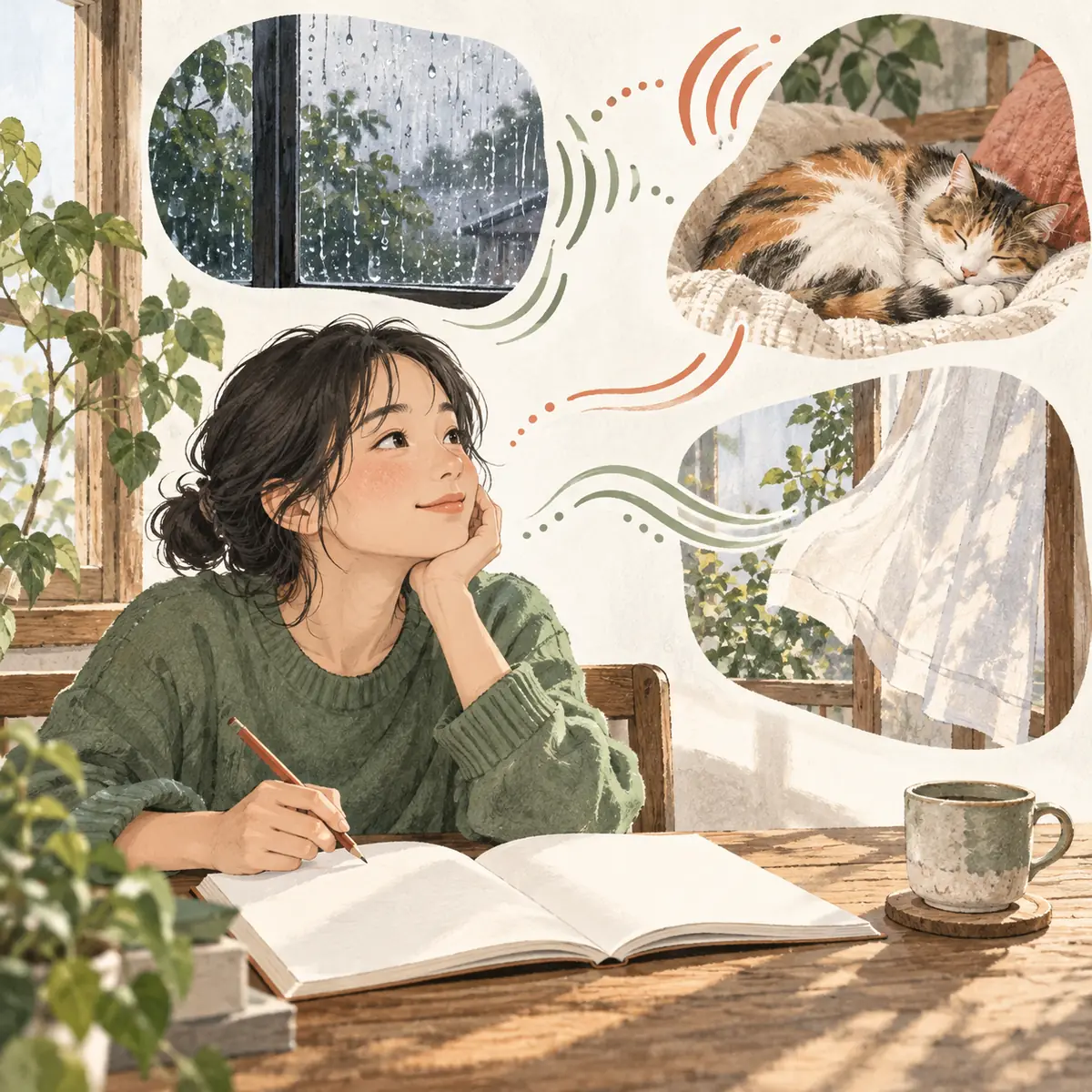
What counts as Japanese onomatopoeia?
In English, onomatopoeia often means a sound imitation such as “buzz” or “clang.” Japanese also uses sound-shaped words for qualities that are not audible: うきうき can describe a cheerful mood, ふわふわ a fluffy texture, and ふらふら an unsteady movement. “Japanese onomatopoeia” is a useful learner label for both sounds and expressive descriptions.
You may see giongo for sound words, giseigo for voices or living sounds, and gitaigo for states and manners. Boundaries vary by reference, so begin with the scene, movement, texture, or feeling you want to describe.
Japanese onomatopoeia examples by category
The tables group Japanese onomatopoeia by the situations where learners are likely to meet them. Romaji uses macrons for long vowels where useful; spelling conventions differ between books and dictionaries. The short Japanese example shows a natural pattern, while the English line gives the intended sense.
Rain, weather, and everyday sounds
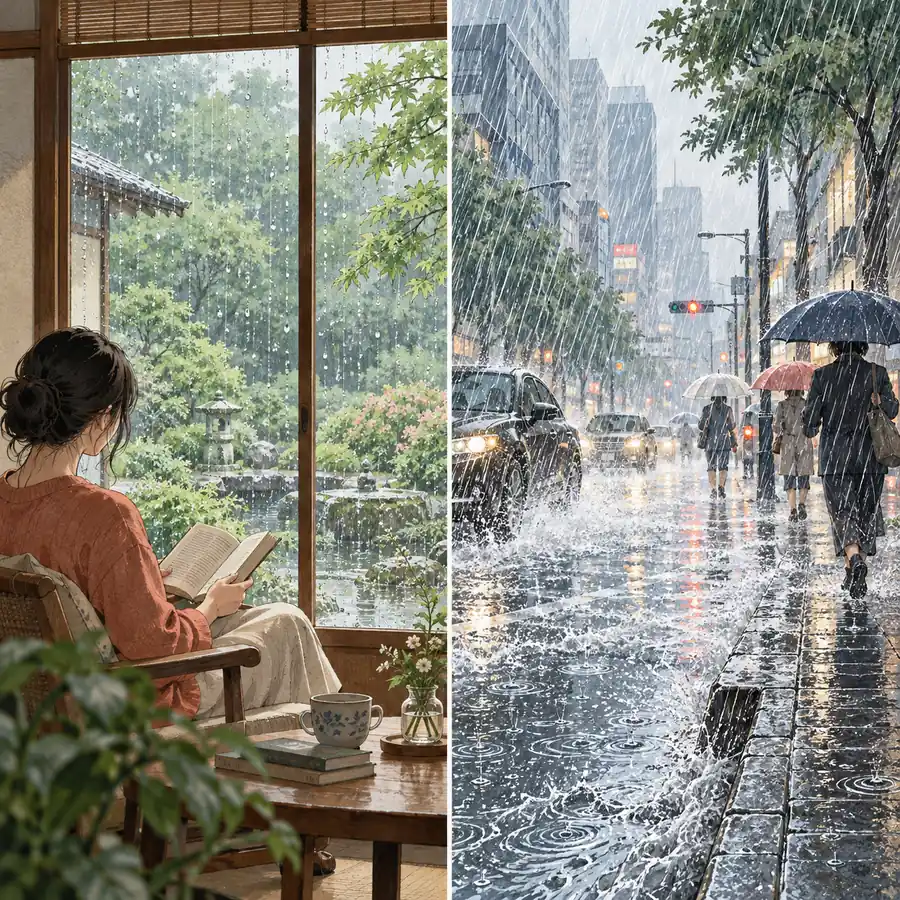
Rain terms show differences in intensity: scattered drops, a gentle fall, or a strong downpour.
| Kana | Romaji | Practical meaning and example |
|---|---|---|
| ざあざあ | zāzā | Heavy, rushing rain: 雨がざあざあ降っている — Rain is pouring down. |
| しとしと | shitoshito | Soft, steady rain: 雨がしとしと降る — A quiet rain falls steadily. |
| ぽつぽつ | potsupotsu | Scattered drops or spots: 雨がぽつぽつ降り始めた — A few drops have started. |
| ぱらぱら | parapara | Light, separate patters: 小雨がぱらぱら降る — A light rain is pattering. |
| ごろごろ | gorogoro | A low rumble or rolling: 雷がごろごろ鳴る — Thunder rumbles. |
| ぴかぴか | pikapika | Brightly shining or flashing: 靴がぴかぴかだ — The shoes are shiny. |
| がたがた | gatagata | A loose, rough rattle: 窓ががたがた鳴る — The window rattles. |
| ぱちぱち | pachipachi | Small crackles or claps: 火がぱちぱち燃える — The fire crackles. |
| こつこつ | kotsukotsu | Steady tapping or effort: 毎日こつこつ練習する — Practise steadily each day. |
| とんとん | tonton | Light, even knocks: ドアをとんとん叩く — Tap gently on the door. |
Animal and human sounds
Animal calls follow Japanese conventions, so they can differ from English “woof” or “meow.” Human forms can describe a voice, a laugh, or sleep.
| Kana | Romaji | Practical meaning and example |
|---|---|---|
| わんわん | wanwan | A dog barking: 犬がわんわん鳴く — A dog barks repeatedly. |
| にゃあにゃあ | nyānyā | A cat meowing: 猫がにゃあにゃあ鳴く — A cat keeps meowing. |
| ちゅんちゅん | chunchun | Small birds chirping: 鳥がちゅんちゅん鳴く — Birds chirp. |
| もーもー | mōmō | A cow's lowing: 牛がもーもー鳴く — A cow goes “moo.” |
| けろけろ | kerokero | A frog's croak: かえるがけろけろ鳴く — A frog croaks. |
| きゃあきゃあ | kyākyā | High, excited cries: 子どもがきゃあきゃあ騒ぐ — Children call out excitedly. |
| にこにこ | nikoniko | Smiling warmly: 彼女はにこにこ笑う — She smiles broadly. |
| しくしく | shikushiku | Quiet, restrained sobbing: 子どもがしくしく泣く — A child sobs quietly. |
| すやすや | suyasuya | Sleeping peacefully: 赤ちゃんがすやすや眠る — The baby sleeps peacefully. |
| どきどき | dokidoki | A pounding heart: 胸がどきどきする — My heart is pounding. |
Feelings, reactions, and body states
These forms quickly suggest excitement, worry, irritation, or relief. You will often meet them in dialogue and manga narration.
| Kana | Romaji | Practical meaning and example |
|---|---|---|
| わくわく | wakuwaku | Excited anticipation: 旅行を楽しみにしてわくわくする — I am excited about the trip. |
| うきうき | ukiuki | Cheerfully buoyant: うきうきした気分で出かける — Go out in a cheerful mood. |
| いらいら | iraira | Irritated or impatient: 待たされていらいらする — I get irritated while waiting. |
| しょんぼり | shonbori | Downcast or disappointed: 失敗してしょんぼりする — Feel down after a mistake. |
| びくびく | bikubiku | Fearful or apprehensive: 物音にびくびくする — Feel jumpy at a sound. |
| ほっと | hotto | Relieved: 無事に着いてほっとした — I felt relieved to arrive safely. |
| むかむか | mukamuka | Nauseated or deeply annoyed: 胃がむかむかする — My stomach feels queasy. |
| くよくよ | kuyokuyo | Dwelling on a worry: 結果をくよくよ気にする — Keep worrying about the result. |
| もやもや | moyamoya | Unclear or unsettled: 気持ちがもやもやする — Feel unsettled or unclear. |
| はらはら | harahara | Anxiously watching: 試合をはらはらしながら見る — Watch the match anxiously. |
Texture, movement, and appearance
Japanese food descriptions often distinguish fluffy, chewy, smooth, and sticky textures. Movement words likewise suggest how something moves.
| Kana | Romaji | Practical meaning and example |
|---|---|---|
| ふわふわ | fuwafuwa | Fluffy, soft, or light: このパンはふわふわだ — This bread is fluffy. |
| もちもち | mochimochi | Chewy and springy: 麺がもちもちしている — The noodles are pleasantly chewy. |
| さらさら | sarasara | Smooth and flowing: 髪がさらさらだ — The hair feels smooth. |
| つるつる | tsurutsuru | Slick or very smooth: 道が凍ってつるつるだ — The path is icy and slippery. |
| ざらざら | zarazara | Rough or grainy: 紙の表面がざらざらする — The paper surface feels rough. |
| ねばねば | nebaneba | Stringy or viscously sticky: 納豆はねばねばしている — Natto is sticky and stringy. |
| べたべた | betabeta | Tacky or unpleasantly sticky: 手がべたべたする — My hands feel sticky. |
| ころころ | korokoro | Rolling in small, light turns: ボールがころころ転がる — A ball rolls along. |
| ぐるぐる | guruguru | Spinning or going around: 頭の中で考えがぐるぐる回る — Thoughts keep circling. |
| ばたばた | batabata | Flapping or rushing about: 朝から準備でばたばたした — I rushed around getting ready. |
Compare similar Japanese onomatopoeia
Contrast pairs make nuance easier to remember. These are not exact opposites; each highlights one useful difference.
| Pair | What changes | Example context |
|---|---|---|
| ざあざあ / しとしと | Strong, rushing rain versus quiet, steady rain. | Choose the word that fits the scene's intensity. |
| わくわく / どきどき | Anticipation and enthusiasm versus a noticeable pounding heart or nervous excitement. | A trip can make you わくわく; a tense moment may make your heart どきどき. |
| ふわふわ / もちもち | Light, fluffy softness versus a springy, chewy texture. | A sponge cake may be ふわふわ; a chewy rice cake may be もちもち. |
Check the surrounding noun and verb: food, mood, and sound create different expectations. The full sentence is usually more useful than a one-word translation.
How to read and pronounce the patterns
Hiragana keeps the sound pattern visible, though real examples may use katakana for emphasis or style. The spelling choice does not always change the meaning.
- Read the rhythm. Repeated forms such as きらきら have two balanced beats.
- Notice small っ. In はっと, it marks a brief stop, not a full “tsu” syllable.
- Listen for long vowels. In ざあざあ, the extended vowel matters; use kana when romaji spellings vary.
- Learn a sentence pattern. Pair words with verbs such as 降る (fall), 鳴く (call), 笑う (smile), or 眠る (sleep).
- Separate sound from state. ふわふわ describes a soft quality, not necessarily a noise.
A short practice routine for Japanese sound words
Do not memorise all 40 words at once. Choose a familiar scene and connect reading, meaning, and use in a short routine.
- Pick one scene. Use rain, food, animal sounds, or a feeling.
- Read kana first. Say the form, checking romaji only when needed.
- Keep one example. Repeat a full phrase to remember its word pairing.
- Make a contrast. Compare quiet rain with a downpour, or fluffy with chewy.
- Recall it later. Hide the gloss, name the scene, and retrieve the kana.
Check unfamiliar characters in the hiragana chart or practise them in hiragana reading practice. The Japanese phrases guide covers reusable expressions; this page focuses on sounds and sensations.
Common mistakes to avoid
- Forcing one English equivalent. Meaning depends on the object, action, and tone.
- Treating repeated forms as interchangeable. Each expression has its own use; do not invent one by repeating a syllable.
- Keeping romaji as the final spelling. Use it as a bridge, then read the kana.
- Confusing texture with sound. Some words describe a state or feeling rather than an audible event.
- Expecting one category system. References may label forms differently; learn the example in context.
For broader vocabulary, use basic Japanese words or the hiragana word list. For word-chain play, see the shiritori word list.
FAQ
What is Japanese onomatopoeia?
It is a learner-friendly label for words that imitate sounds and words that evoke states, movement, texture, or feelings. わんわん imitates a dog's bark; ふわふわ describes something fluffy or light.
What is the difference between giongo and gitaigo?
Giongo usually refers to sound words; gitaigo describes a state or manner. References may divide the categories differently, so use the labels as a guide.
Do Japanese sound words always repeat?
No. Repetition is common, but not universal. Learn each word in a phrase instead of inventing a form by repeating a syllable.
Should I learn Japanese onomatopoeia with romaji?
Romaji can help at first, but make kana your main reference. Long-vowel spellings vary between romaji systems.
Can one Japanese sound word have more than one meaning?
Yes. Check the noun, verb, and situation before choosing an English meaning.
Summary
Japanese onomatopoeia describes noises as well as textures, movements, and feelings. Start with familiar examples, read them in kana, and attach each one to a sentence. Compare ざあざあ with しとしと, then revisit words in context instead of relying on one English gloss.
Related guides: basic Japanese vocabulary, common Japanese phrases, and Japanese learning games.